
Maharashtra Class 6 Textbooks Drop Caste Inequality References, Recast Scientific History
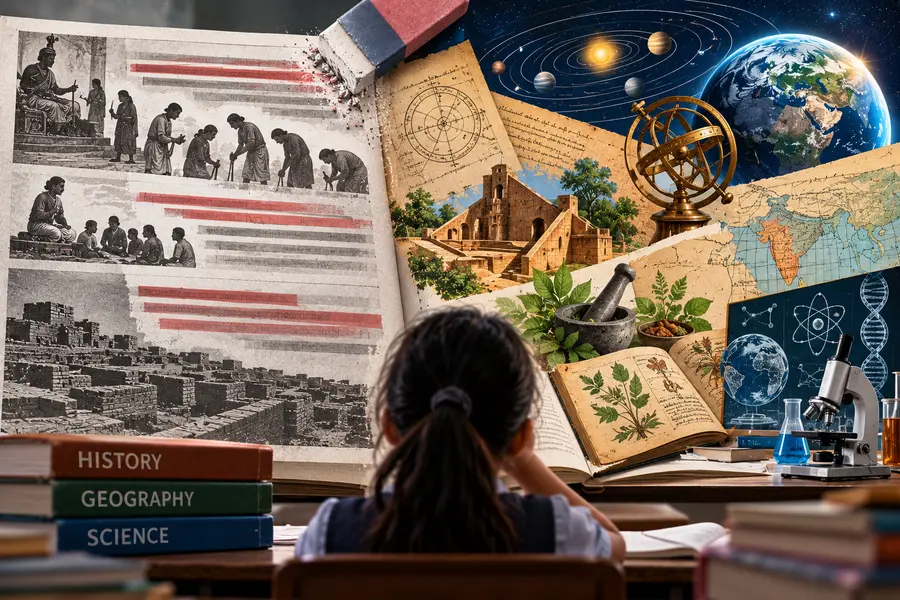
Maharashtra’s revised Class 6 history, geography and science textbooks have removed or shortened certain passages on caste inequality, priestly privilege and the decline of the Harappan civilisation, while introducing new explanations rooted in ancient Indian scriptures and knowledge traditions.
Introduced this academic year by Balbharati, the state’s textbook bureau, the revisions follow the National Education Policy (NEP) 2020 and its emphasis on Indian Knowledge Systems (IKS). A comparison of the old and new textbooks by The Indian Express identified changes in the treatment of caste and religious history, as well as the presentation of ancient Indian ideas alongside established scientific explanations.
References to caste and social inequality revised
Some of the most significant changes concern how the history textbook explains social structures and the emergence of religious movements in ancient India.
The earlier edition explained how the varna system, initially associated with occupation, became hereditary and contributed to caste-based inequality. The revised textbook replaces that explanation with a brief statement that Vedic society was divided into four varnas: Brahmana, Kshatriya, Vaishya and Shudra.
A passage discussing the control exercised by the priestly class over knowledge of sacrificial rituals has also been removed. The earlier text described how restrictions on access to ritual knowledge strengthened the varna system and made social status increasingly dependent on birth rather than achievement.
The new version instead states that Vedic people performed sacrifices, known as yajnas, and worshipped nature, while placing greater emphasis on Vedic values and moral duties.
The explanation connecting caste discrimination with the emergence of Jainism and Buddhism has also been dropped. However, references to the teachings of Mahavira and Buddha opposing discrimination based on birth remain.
The revised text says Mahavira taught that a person's greatness depended on conduct rather than varna. It similarly states that Buddha rejected discrimination based on varna and held that a person's behaviour, rather than birth, determined their greatness.
The earlier textbook explained that new religious movements emerged around the sixth century BCE partly in response to social inequalities and sought to make religious ideas more accessible to ordinary people. The revised version replaces that account with a discussion of India's religious diversity.
The section on the decline of the Harappan civilisation has also changed. While the earlier textbook listed invasions by foreign tribes among the possible causes, the new edition cites changes in river courses, natural calamities and declining trade with Sumer as factors.
Scientific explanations placed alongside ancient traditions
The revised science and geography textbooks introduce more references to ancient Indian scholars and scriptures, placing traditional accounts alongside concepts explained through modern scientific frameworks.
The geography textbook introduces a section on the history of Indian geography that draws on the Vedas, Puranas, Upanishads and Suryasiddhanta. It describes the Earth through the concept of Saptadweep, or seven islands, and maps these descriptions onto modern geographical regions. It also equates the ancient Kshir Sagar with the Indian Ocean and Kshar Samudra with the Arctic, while presenting the Vedic account of the universe's creation alongside the Big Bang theory.
The treatment of the prime meridian has also changed. The earlier textbook identified Greenwich as the prime meridian, whereas the new edition says ancient Indian astronomers considered Ujjain the centre of the Earth and proposed the concept of a base longitude. It also introduces traditional units of time such as ghatika and muhurta.
In science, the chapter on force and pressure discusses Bhaskaracharya II alongside Isaac Newton in its explanation of gravitational force. It states that Bhaskaracharya wrote in Siddhanta Shiromani, around 950 years ago, that the Earth attracts objects towards itself.
Another addition credits Aryabhata with explaining that the Earth revolves around the Sun. A section in the chapter Beyond the Sky also states that the time calculated by Aryabhata and measurements made using modern instruments are exactly the same.
References to Ayurveda and ancient medical knowledge have also expanded. Charaka is introduced as the founder of Ayurveda, while his classification of animals features in a chapter on living organisms. The textbook also draws on the Rigveda while discussing dietary practices and seasonal changes.
The history textbook devotes more space to Sushruta, describing him as the father of surgery and explaining his technique for reconstructing the nose. It states that surgical methods documented in the Sushruta Samhita were subsequently studied and adopted by Europeans in the 18th century.
Chanakya, who received only a brief mention in the earlier edition, now has a separate passage discussing his Arthashastra and his role in Chandragupta Maurya's rise to power. The book describes the text as dealing with governance, taxation, defence, intelligence and politics.
Changes echo NCERT's revised curriculum
Several revisions resemble those introduced in the National Council of Educational Research and Training's Class 6 social science textbook, Exploring Society: India and Beyond, released in 2024.
The NCERT textbook also refers to Ujjain as an ancient Indian meridian, known as Madhya Rekha or Ujjayini, predating the Greenwich meridian. It uses the term Sindhu-Sarasvati civilisation for the Harappan civilisation and gives less space to caste than the earlier textbook, which included a section on caste discrimination and B R Ambedkar.
Both sets of revisions reflect the emphasis on integrating sangh parivar propaganda into school curricula.
Balbharati says revisions follow NEP recommendations
Balbharati director Anuradha Oak said the textbook revisions were undertaken in accordance with NEP 2020 recommendations.
According to her, the references were intended to familiarise students with India's historical contributions and provide a foundation for those interested in pursuing such subjects in higher education.
Concerns over the politicisation of history and science education
The revisions have renewed broader questions about the direction of school education under the NEP 2020 and the BJP-led government's approach to history and science curricula.
Critics of the BJP and the Sangh Parivar's ideological approach to education have argued that an emphasis on ancient Indian traditions, when accompanied by the removal or dilution of accounts of caste oppression and social inequality, risks presenting a selective version of the past. They have also raised concerns that religious texts and traditional knowledge may receive greater prominence than critical, evidence-based explanations of historical and scientific developments.
The changes to the Maharashtra textbooks bring these concerns into focus. The removal of a detailed explanation of how caste became hereditary and entrenched inequality, alongside the introduction of scriptural accounts of geography and cosmology, raises questions about how students are encouraged to understand the relationship between historical traditions, social structures and scientific evidence.
Critics argue that incorporating traditional knowledge into school education should not come at the cost of scientific rigour, historical context or an honest account of social inequalities.
The central question raised by the textbook revisions is whether the inclusion of Indian traditions will broaden students' understanding of history and science or encourage a selective narrative in which religious and cultural claims take precedence over critical inquiry and documented social history.



Related News
Dont Miss it







0 comments