
Jharkhand SIR Row: BJP Agents Deliberately Targeting Minority Voters with Mass Deletion Forms to Refuse Voting Rights, Sparks Standoff
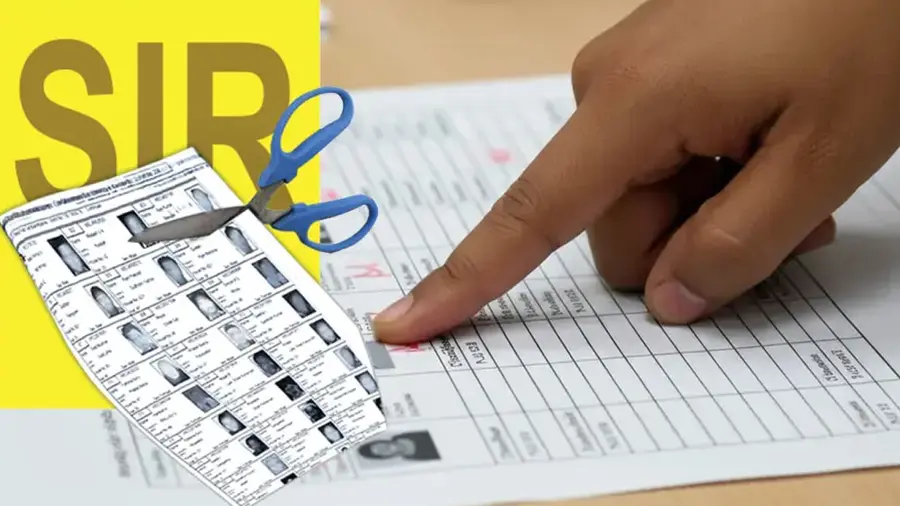
Ranchi: An investigative report published by The Indian Express has revealed a contentious pattern in Jharkhand’s Godda district, where Booth Level Agents (BLAs) of BJP have filed bulk applications seeking the deletion of minority voters from electoral rolls. The developments have triggered direct friction between grassroots election workers and political operators, escalating into a major political flashpoint.
The controversy centers around the ongoing Special Intensive Revision (SIR) of electoral rolls in the state. According to the investigation, BJP BLAs across multiple booths—including areas like Maheshtikri, Pachua Kita, Lochni, and Baghakol—submitted stacks of Form 7 applications, which are legally mandated for raising objections or requesting the removal of names.
Ground checks by the news outlet revealed that these targeted deletion requests were overwhelmingly aimed at minority residents, such as Abdul Mannan Khan, Mohammad Naushad, and Mohammad Aslam.
Tracking down several of the targeted individuals, The Indian Express found that many have lived in their respective villages for generations. Crucially, their credentials had already been officially mapped and verified back to the state's comprehensive 2003 intensive electoral revision list—a status that should have firmly secured their place on current registries.The friction spilled into open defiance at the ground level when Booth Level Officers (BLOs) balked at accepting bulk, irregular documents.
At Pachua Kita village, tension escalated when a local BLO questioned a BLA who arrived with roughly 75 unauthorized deletion forms. The agent reportedly admitted he was under the impression the paperwork was meant for additions, and proceeded to burn all 75 forms on the spot. Similarly, in Maheshtikri’s Booth No. 9, a BLO restricted intake after local block authorities flagged that the submitted papers deviated from official formats.
The targeted filings have left local residents deeply anxious. Villagers expressed fears that systematic efforts to strip them from voter registries could jeopardize not only their democratic franchise, but also their access to essential government welfare benefits and basic citizenship recognition.
The confrontation has drawn sharp reactions across the political spectrum. Local ruling alliance figures and opposition leaders have slammed the bulk filings as a calculated conspiracy to disenfranchise minority voters.
Defending the process, former BJP Godda MLA Amit Kumar Mandal maintained that filing objections against ineligible entries is a routine, authorized part of a BLA's duties and training. The party also lodged complaints against BLOs for refusing statutory forms.
The Special Intensive Revision (SIR) process in Jharkhand officially commenced on June 30. The initial enumeration phase concluded, and the draft electoral roll was published on August 5.
Figures released by the Chief Electoral Officer’s office indicated that out of over 2.64 crore registered voters, more than 43.74 lakh voters faced potential exclusion or removal from the lists because they did not submit signed enumeration papers during the initial door-to-door drive. This translated to approximately 16.48% of voters facing deletion threats in the draft phase.
Opposition parties and civil society critics strongly condemned the BJP, accusing the party and its grassroots operators of weaponizing the ECI to orchestrate a systematic purge of minority communities and marginalized sections from the electoral rolls.
Investigations like the one by The Indian Express revealed that BJP Booth Level Agents (BLAs) selectively filed bulk deletion applications against generational minority residents whose citizenship and legacy residency had already been mapped back to historical records like the 2003 rolls.
Opposition argue that these targeted maneuvers are deliberate attempts to shrink the minority vote bank in politically sensitive or marginal constituencies, undermining democratic representation under the guise of administrative revision.
The controversy surrounding the SIR is part of a broader nationwide pattern observed across non-BJP-ruled states over the past year, where similar intensive revisions triggered massive political pushback:
When the ECI rolled out the SIR in states like Keralam and Tamil Nadu ahead of their respective electoral cycles, political parties and state governments heavily opposed the move. In Keralam, the process removed an estimated 25 lakh voters. In West Bengal alone, 90 lakh people lost their voting rights. Meanwhile, in Uttar Pradesh, a BJP-ruled state, the number of voters reportedly increased by 84 lakhs.
Opposition argued that strict document mandates (such as refusing standard local IDs and demanding complex proof of parentage/domicile) mirrored a "de facto NRC" (National Register of Citizens) intended to target minorities, Dalits, and economically weaker sections.



Related News
Dont Miss it







0 comments