
Professor Suspended at Jamia Millia Islamia Over Exam Question on Muslim Atrocities

Web desk
Published on Dec 24, 2025, 04:59 PM | 3 min read
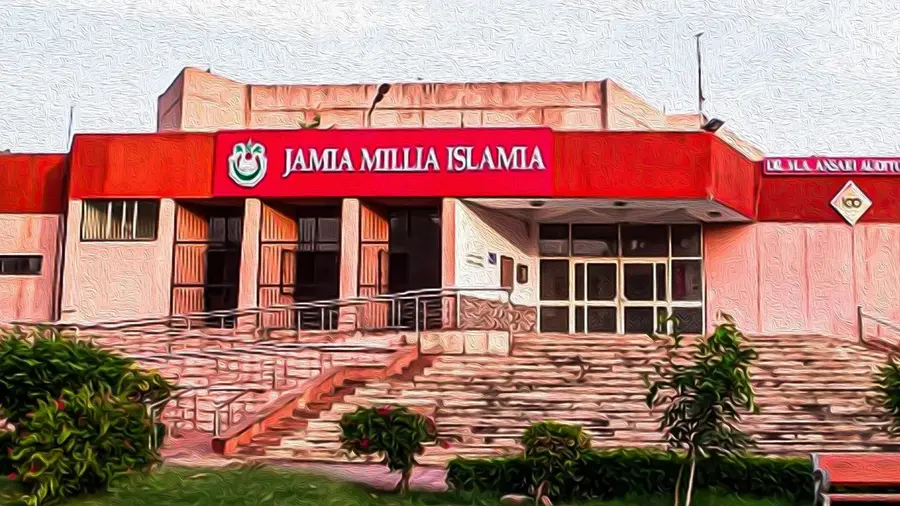
New Delhi: A professor at Delhi’s Jamia Millia Islamia (JMI) has been suspended after setting a semester examination question addressing a politically sensitive issue: the treatment of Muslim minorities in India. The university has also constituted an inquiry committee to examine the matter.
The question, part of a BA (Hons) Social Work first-semester paper titled Social Problems in India, asked students to "discuss the atrocities against Muslim minorities in India, giving suitable examples.' Prof Virendra Balaji Shahare created the test.
Although the question reflects documented social realities faced by minority communities, its circulation on social media triggered sharp reactions, particularly from right-wing circles. Kanchan Gupta, senior adviser to the Ministry of Information and Broadcasting, shared the suspension notice on X, describing the question as “malicious” and hinting at political bias.
Following the backlash, JMI suspended Prof Shahare, citing the need to uphold “academic responsibility and institutional discipline.” The suspension order mentioned that a police FIR would be filed “as per rules,” though officials later clarified that no police case is currently being pursued, and the matter is being examined internally.
Critics argue that the reaction exposes a worrying trend: inconvenient truths about minority persecution are increasingly politicised and suppressed. “Atrocities against minorities are a reality in contemporary India,” said an academic who requested anonymity. “Yet, even raising these issues in an academic context is treated as an attack on the government.”
The episode raises broader questions about academic freedom and the right of students to engage with uncomfortable truths. The inquiry committee will examine whether the question violated university norms, but the controversy itself underscores the chilling effect political pressures can have on educational spaces.
Until the committee submits its report, Prof Shahare remains suspended, confined to New Delhi and barred from leaving without prior permission. The debate continues over whether students should be shielded from discussing politically sensitive yet socially significant realities.
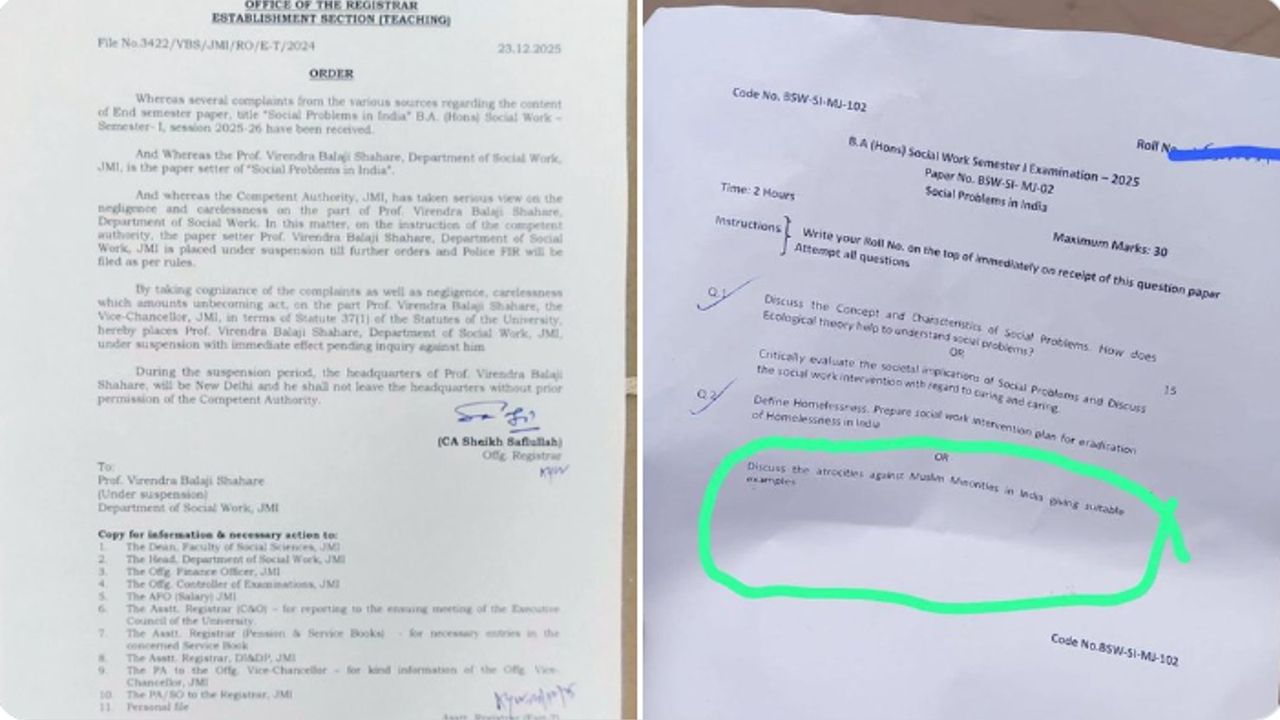 Question Paper
The JMI case is part of a wider pattern of disciplinary actions against academics perceived as challenging political narratives. In May 2025, Ashoka University’s Associate Professor of Political Science, Dr Ali Khan Mahmudabad, was arrested by Haryana Police for social media posts relating to India’s military actions.
Although his posts were intended to praise female leadership in the military, he was charged under laws concerning communal disharmony and subversion, sparking concerns about academic freedom. He was later granted bail, with supporters arguing he was targeted for expressing dissent.
Since the BJP-led NDA government assumed power in 2014, several disciplinary measures against faculty in central universities have drawn criticism for political undertones. At South Asian University, Professor Snehashish Bhattacharya was terminated for supporting student protests, a move widely condemned by teachers’ associations as vindictive and an abuse of administrative authority.
Beyond these high-profile cases, faculty at institutions such as JNU, Delhi University, and Mahatma Gandhi Central University have faced suspensions, show-cause notices, and restrictions on academic activity, often linked to political sensitivities rather than genuine academic misconduct.
Teachers’ bodies like FEDCUTA and JNUTA have repeatedly condemned these measures, highlighting a broader trend of tightening administrative control since 2014. The cumulative effect has been a climate of polarization on campuses, where dissenting voices face heightened scrutiny, critical inquiry is curtailed, and trust in higher education governance is increasingly strained.



Related News
Dont Miss it







0 comments