
Federal Relations and Fiscal Equity under threat

Dr. P S Sreekala
Published on Feb 11, 2026, 03:32 PM | 5 min read
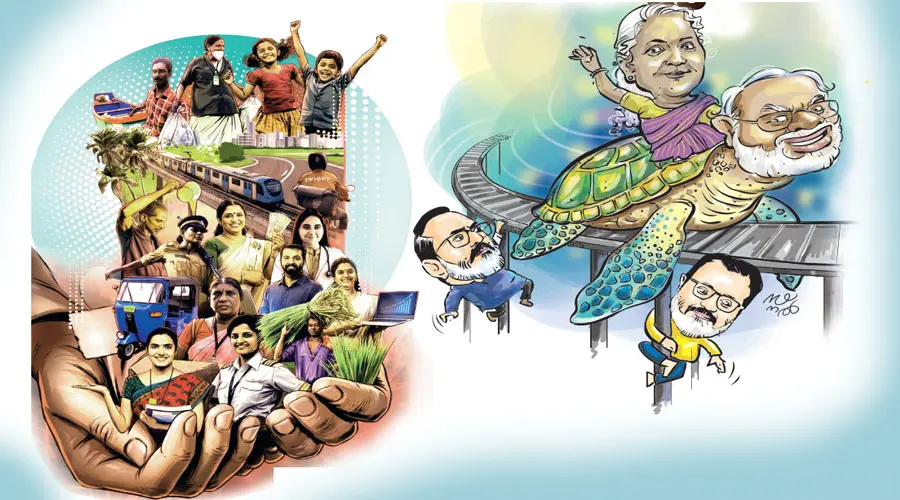
Budgets are not neutral fiscal statements; they are documents that disclose the priorities of the Governments. A comparative reading of the Kerala State Budget and the Union Government Budget of India reveals two contrasting approaches to the people and the nation itself.
On 1 February 2026, India’s Finance Minister presented the Union Budget 2026-27, outlining the government’s fiscal priorities for the year. While the official narrative emphasised stability, growth, and targeted investment, the real picture which the budget put forward is the low priority given to welfare sectors like education, health, and rural employment. At the same time, high allocations to defence and corporate-focused areas.
On January 29th, Finance Minister of Kerala presented the state budget 26-27, in which the policy measures and the major priority given to the welfare sector can be seen.
While the Union Budget repeatedly focuses on the defence sector and corporate interests, the Kerala Budget continues to prioritise welfare, such as education, social security pension and labour etc. The contrast is visible when examined through sectoral allocations.
In the Union Budget, the allocation for defence is the single largest item of expenditure. Defence allocation now stand at 7.85 lakh crore rupees the highest among all Ministries. 1.39 lakh crore earmarked for procurement from domestic defence industries. In financial year 2025-26 the allocation for defence was 2.19 lack crore rupees. The hike is more than 5 lakh crore. This reflects the priority of the central government. Such spending directly neglects the labour force and vulnerable sections in the society. Despite such high allocations to defence, national security remains under threat. This naturally raises the question: where are these allocated funds going?
The social sector spending remains low relative to India’s population and needs. The Union Government’s allocation for education is approximately 1.39 lakh crore rupees, which constitutes barely 3 per cent of total expenditure and well below the long-advocated target of 6 per cent of GDP (recommendation of Kothari Commission). Allocation for health sector is merely 1.05 lakh crore which is very low with respect to the health status of the majority of Indian population.
Union government assures that the employment days under MGNREGA will be raised to 125 days. It is a program providing right-based guarantee of work to rural households. But it is a paradox that the allocation for this rural employment scheme is only 30,000 crores rupees in the budget. India’s flagship rural employment and livelihood support programme MGNREGA was recently restructured with change in name as Viksit Bharat–Guarantee for Rozgar and Ajeevika Mission (Gramin) VB-G RAM G. MGNREGA is rights-based and fully central funding model ensured work without burdening states. Actually the rural distress demanded expanded employment support. At the same time, the new VB-G RAM G introduces cost-sharing and conditionality, potentially reducing real access to guaranteed employment. This is the Government's tactical attempt to move away from guaranteed employment. This compels rural workers to accept insecure and low-paid employment. This is against the interest of ensuring livelihood of the poor.
At the same time, the Kerala Budget, though far smaller in absolute terms, demonstrates a different allocation logic. Kerala’s total budget size is around 1.7–1.8 lakh crore rupees, yet a disproportionately high share is devoted to social sectors. Expenditure on health consistently exceeds 2500 crore rupees, supporting an extensive public healthcare network that reduces dependence on private providers. Education spending, including school, higher, and technical education, accounts for nearly 15 per cent of state expenditure, reinforcing the idea of education as a public good. The infrastructure as well as the quality of education sector has been given a major focus in the budget.
Kerala’s commitment to social security pensions-old-age, widow, disability, and agricultural worker pensions-is very much visible in the budget. The allocation for welfare pension is 14,500 crore rupees. These transfers constitute a social wage, supplementing labour incomes. Food security programmes and housing schemes further strengthen this protective measures.
Local self-government institutions receive close to 20–25 per cent of plan expenditure in Kerala, a reflection of democratic decentralisation. This allocation enables the local self-governments to function on its own decision making power. The idea of decentralisation gets a full-fledged autonomy. In contrast, the Union Budget increasingly channels funds through centrally sponsored schemes with strict conditionalities, limiting states’ autonomy and reinforcing central control over fiscal priorities.
The employment strategy reflected in two budgets are also divergent. While the Union Government reduces expenditure on direct employment guarantees, Kerala continues to invest in state-supported livelihood programmes, including women-centric initiatives like Kudumbashree. Such programmes enable the social empowerment also.
The fiscal treatment of Kerala by the Union Government must be understood structurally. Kerala’s higher wages and extensive welfare spending challenge the neoliberal model that prioritises labour flexibility and low social expenditure exhibit by Union government. Fixing tight borrowing limits, and conditional grants constraining states that pursue welfare and development policies. India's unique fiscal federalism thus becomes overruled.
In short, the defence focused Union Budget and welfare-oriented Kerala budget reflects two policies. The first one is anti-labour and oriented towards centralisation, while the second one is welfare focused and inclined to decentralisation. The Union Budget’s huge allocation to defence reveals a state aligned with imperialistic views. Kerala’s budget, though amid fiscal constrain demonstrates alternative priorities-health, education, social welfare - and labour friendly attitude are possible. Education up to the degree level in Arts and Science Colleges has been made free; social security pensions for women between the ages of 35 and 60; a group insurance scheme for the Haritha Karma Sena (green army- waste management team); and a 1000 rupees hike in the wages of ASHA workers are some examples of the social orientation of the Kerala Budget 2026–27.
The marginalisation of Kerala in Union fiscal policy is not merely regional neglect but a reflection of a deeper enmity towards federalism. The Centre’s share of tax devolution and grants to states has declined, which weakens federal relations and fiscal equity.



Related News
Dont Miss it








0 comments