

Nepal Floods: Death Toll Crosses 700, Nearly 2,500 Still Missing
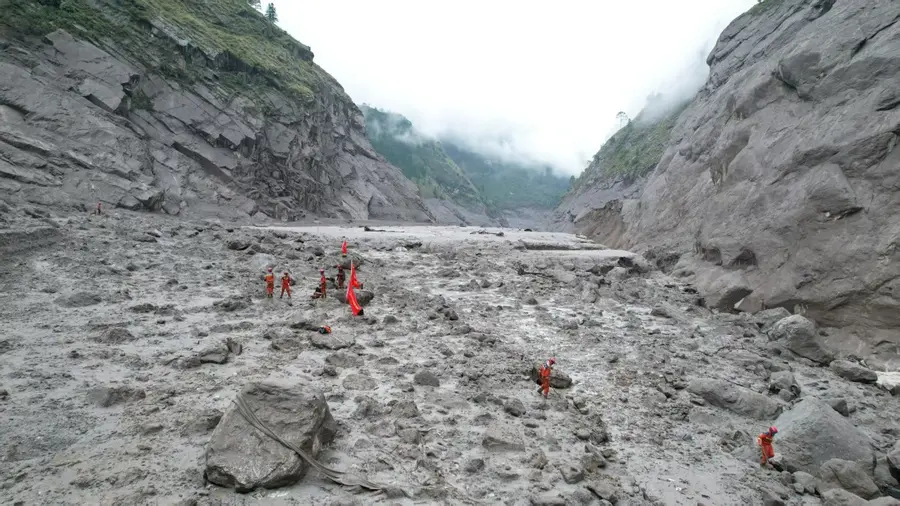
This aerial photo shows members of the Lhasa Fire and Rescue Mobile Detachment conducting search and rescue operations at Gyirong Port days after the August 26 mudslide which destroyed the port, in Gyirong County, in China’s western Tibet region on August 29, 2026. (Photo | AFP)
Kathmandu: Five days after a catastrophic flash flood tore through the Nepal-Tibet border, the death toll in Nepal has climbed past 680 with more than 2,500 people still missing, even as rescue operations shift from search-and-rescue to search-and-retrieval in the worst-hit valleys.
Nepal's National Disaster Risk Reduction and Management Authority said the confirmed death count had reached 734, with nearly 2,500 people still unaccounted for. Across the border in China's Tibet Autonomous Region, where a mudslide flattened the Gyirong Port border crossing, officials raised the death toll to 16 as the number still missing eased slightly to at least 546, including 261 foreigners. It remains unclear how much overlap exists between the Nepali and Tibetan missing-persons counts. Nepal's disaster authority said more than 4,500 people had been rescued nationwide, including 227 foreign nationals, while 219 injured people had been treated or discharged.
Rescue teams described worsening conditions on the ground. Search efforts have largely moved into recovery mode, with soldiers combing riverbanks and debris fields for bodies rather than survivors. Nepal's government said it would preserve DNA samples from unidentified victims before burial, given the scale of decomposition and the number of bodies that may never be identified through visual means. Officials have also flagged that flood survivors are now facing a second crisis, with medicine and clean water running short in several affected districts, even as damaged roads and disrupted mobile networks continue to hamper both rescue and relief work.
India's Ministry of External Affairs has issued a series of updates on Indian nationals caught up in the disaster. On August 29, MEA spokesperson Randhir Jaiswal said, so far, 108 Indian nationals have been rescued, while 275 remain missing.
Four Indian nationals were rescued on Saturday from a hydropower project in Nepal’s Rasuwa district and are expected to reach Kathmandu shortly. They have been identified as Ripu Kumar, Chaneshwar Narzary, Kripa Shankar and Mohammed Minhajuddin, the External Affairs Ministry said.
As many as 128 persons of Indian origin are also reported missing as authorities continue efforts to trace those who are reported to be missing. Meanwhile, 598 Indian nationals crossed into Nepal from China on, the MEA said, citing local government sources.
The MEA further said as many as 900 Indians are yet to depart China, but they remain safe and the Indian Embassy in Beijing is in touch with them directly or through the local government. The MEA also said it has re-established contact with 50 nationals.
India has mounted a sustained relief operation since the disaster struck on August 26. The first tranche — 10 tonnes of humanitarian assistance and disaster relief material, including essential medicines, temporary shelters, blankets, hygiene kits and solar lamps — was flown to Kathmandu aboard an IAF C-130J aircraft within hours.
A second aircraft carrying 37.5 tonnes of relief material, medical supplies and NDRF equipment followed on a C-17 Globemaster. By August 29, India's cumulative relief consignment had reached roughly 57.5–57.6 tonnes, alongside an 11-member team of medical personnel and tunnel-rescue specialists deployed to assist Kathmandu. Union Home Minister Amit Shah said NDRF teams had been placed on high alert in Indian border districts, and that he had spoken with the chief ministers of Bihar and Uttar Pradesh about the disaster's potential downstream impact.
Nepal's government has repeatedly stressed that its own security forces are managing the crisis. Prime Minister Balendra Shah said more than 11,000 security personnel — including over 5,000 Nepal Army soldiers — had been deployed for search and rescue, with 16 helicopters (Nepal Army and private) having together flown 236 sorties. Officials said Indian and Chinese experts were assisting the Nepal Army in the operation.
Nepal's Foreign Ministry said it had received offers of search-and-rescue assistance from India, China, the United States, the United Kingdom, Japan, South Korea, Sri Lanka and Bangladesh, among others, but has so far turned down foreign rescue teams, saying its own agencies have the capacity to handle the operation and requesting assistance in other fields.
South Korea, which has nationals missing, said it was still negotiating with Kathmandu over allowing its personnel into affected areas and has already sent a response team. The United States has raised its humanitarian assistance to Nepal to $3.6 million, up from an initial $500,000, the State Department said, with around 90 Americans still unaccounted for as of the latest count.
In Tibet's Gyirong county, where the flood destroyed a major border crossing and trading post with Nepal, Chinese authorities said rescue and search operations were continuing amid renewed caution over a further rise in the Bhote Koshi river. Firefighting and rescue units — including sniffer dogs, drones and heavy vehicles — have been searching the debris field, though officials said the area near the border checkpoint had been almost entirely flattened, with little sign of surviving structures or survivors.
Premier Li Qiang travelled to the affected area to oversee the response in its early days, and President Xi Jinping had earlier called for "all-out" search efforts and stronger monitoring systems to guard against secondary disasters.
Bodies recovered in Uttar Pradesh
The flood's reach has extended well beyond Nepal's borders. Bodies believed to be victims of the disaster have continued to surface roughly 240 km downstream in IUttar Pradesh, in the Kushinagar and Maharajganj districts that border Nepal's flood-affected Chitwan region. Seven bodies — four recovered from the Gandak (Narayani) river in Maharajganj and three in Kushinagar — have been retrieved so far, comprising five women and two men, according to officials cited by BBC Hindi. The bodies, found in severely decomposed condition, remain unidentified; authorities in both districts say they are coordinating with counterparts in Nepal to help establish who they were.
Tags



Related News
Dont Miss it









0 comments