
Nearly 1,400 missing, death toll climbs past 270 as search continues in Nepal-Tibet flood zone
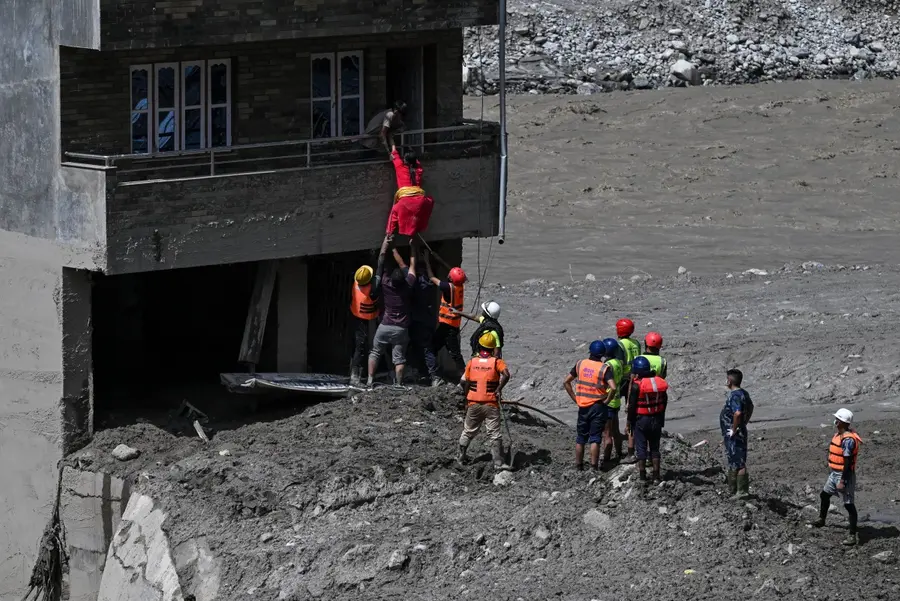
Police personnel rescue stranded residents from a house buried in sludge after flash floods at Trishuli in Nepal's Nuwakot district on August 27, 2026. (Photo | AFP)
Kathmandu: Rescue teams are searching for nearly 1,400 people, most of them tourists, after Wednesday's catastrophic flash flood tore through the Nepal-Tibet border region, flattening entire villages and killing at least 270 people so far.
The search for the missing — among them hundreds from India, the United States, United Kingdom, Australia and Canada — has been hampered by the loss of dozens of bridges and nearly 25 miles (40km) of road across the mountainous, trekker- and pilgrim-heavy region. Bodies have been recovered hundreds of miles downstream in Nepal's Chitwan district, near the Tibetan border, and dozens of injured survivors have been flown to Kathmandu for treatment. By Thursday morning, the Nepali army had airlifted more than 100 people to safety.
Nepali police and tourism officials said almost 600 foreigners were among 826 people missing in Nepal, including 177 Indians, 63 Americans, 34 Australians, 33 Britons and 25 Canadians. Chinese state media reported at least 558 missing on the Tibet side, of whom at least 260 were foreign nationals. Nepal police said 270 bodies had been recovered by Thursday afternoon local time, while Chinese state media reported three dead in Tibet. Many of the victims were pilgrims travelling to Kailash Mansarovar, a high-altitude Himalayan site.
Early Nepali government reports suggested an earthquake may have triggered the collapse of a glacier's lower section, but the US Geological Survey later said what was initially recorded as a 4.4-magnitude quake was in fact a seismic shock from a glacial rock-and-ice collapse and the resulting debris flow. "No earthquake had occurred," the agency said.
The Kathmandu-based regional body ICIMOD told Deshabhimani that the fash floods were most likely triggered by a large rock-ice avalanche rather than a conventional glacial lake outburst flood, according to a preliminary assessment. Early evidence points to a massive slope failure that sent ice, rock and debris crashing into the valley, possibly forming a temporary dam across the river that later gave way.
The precise cause of that initial failure — whether driven by glacier instability, bedrock weaknesses, or climate-related changes in the region's ice and snow systems — remains under investigation, ICIMOD Cryosphere Analyst Prashant Baral said.
International response
UN Secretary-General Antonio Guterres said UN teams and partners were mobilising supplies and personnel for affected communities. India has sent two consignments of relief supplies to Nepal since the floods and the US government pledged $500,000 in emergency assistance. China deployed nearly 800 emergency workers and 150 vehicles, along with sniffer dogs and speed boats, according to Xinhua News Agency. Chinese Premier Li Qiang travelled to the border area on Thursday to oversee search efforts.
Tags












0 comments