
War Far Away, Consequences at Home: Why the West Asian Conflict Matters for India

Rahna Mariyam
Published on Mar 11, 2026, 12:45 PM | 5 min read
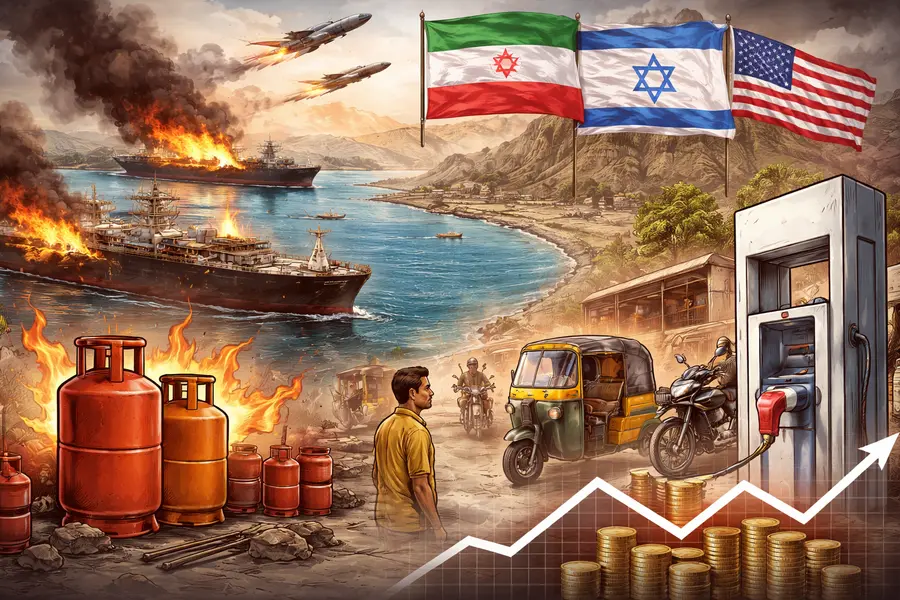
Nowadays, the wars, wherever in the world tehy are fought, do not remain confined to he war zone. In an interconnected world, a missile strike in West Asia has the potential to quietly transform the economy thousands of kilometers away. The ongoing escalation triggered by initial attacks by US and Israel on Iran, followed by Iran's counterattack on US-Israel and their allies in the region is a reminder that geopolitics and everyday economics are deeply intertwined. For India and particularly for Kerala, this conflict may have far-reaching implications beyond diplomacy and international relations.
At the centre of the crisis lies one of the most critical choke points in global energy supply: the Strait of Hormuz. One-fifth of the world’s oil supply passes through this narrow waterway connecting the Persian Gulf to global markets. Any disruption of supply through this route is immediately felt on the energy supply front. Even rumours of disruptions can push oil prices upward, and the present conflict has already created significant volatility.
For countries that produce oil or whose economy depends primarily on oil imports, rising prices may mean windfall profits. But, for countries like India, however, it means vulnerability. India is a major importer of crude oil and natural gas. This dependency makes the country highly sensitive to geopolitical shocks originating in West Asia.
The first signs of this are already beginning to appear. Reports of delays in commercial LPG supplies and a hike in fuel costs indicate that disruptions in the global energy chain are beginning to affect the Indian economy, clearly showcasing the ripple effect. Restaurants and small businesses that are heavily dependent on cooking gas have already started to suffer. While these shortages may appear minor at first glance, they reveal a deeper structural weakness: India’s reliance on external energy supplies.
Rising oil prices inevitably trigger inflation. Transportation costs increase, which pushes up the price of food, consumer goods, and construction materials. For households already grappling with rising living expenses, even small increases in fuel prices can have a large impact. Inflation does not merely affect economic statistics; it shapes daily life, from grocery bills to electricity costs.
Meanwhile, another aspect of the current crisis is whether the government of India is prepared for such a crisis. For instance, over the last decade or so, there have been repeated warnings of how vulnerable India is to global events due to its overreliance on imported fuel. For example, since the Russia-Ukraine war and various global events in recent times, India was never really in a position to advance in finding a permanent solution for its overreliance on imported fuel. For instance, its petroleum reserve levels were always low compared to its consumption levels. Meanwhile, its overreliance on imported fuel is not limited to petroleum products only. Its overreliance on imported gas is another issue that was not really addressed by the government of India in recent times.
The crisis also exposes the limits of the government’s claims about Piped Natural Gas (PNG) as a reliable energy alternative. While the BJP-led NDA government has promoted PNG expansion as a major step toward energy security, much of the gas still depends on imported LNG transported through volatile regions like the Strait of Hormuz. During geopolitical crises, these supply chains become vulnerable to disruptions and price shocks. This reveals that PNG infrastructure alone cannot shield India from global energy instability. The gas shortages and fuel price hikes in India in recent times highlight how vulnerable India is to global events in terms of its overreliance on imported fuel.
At the same time, it is important to note that the causes of India’s energy vulnerability are not to be linked to the current government alone. The increasing reliance on imported hydrocarbons is a trend that has been followed over several decades, even under governments headed by the Indian National Congress party.
Related News
This unpreparedness of the government and its impact could be even more pronounced in Kerala. The state has long been tied economically and socially to the Gulf region. Lakhs of Malayalis live and work in Gulf countries. They send remittances back home, which is one of the pillars of Kerals's economy.
If this conflict destabilises the region or a slowdown in economic activity in Gulf states, it could have a cascading impact on Kerala's economy. Even a modest decline in remittance flows could affect consumer spending, real estate investments, and small business growth across the state.
Though the conflict in Iran, Israel, and US is still in its nascent stages, it is a reality that it is indicative of a larger issue in a globalised economy. No state is distant enough from conflict in a globalised economy. Conflicts in distant lands are capable of changing the economic landscape of a state in ways that are not immediately apparent. In this regard, it is a reality that India and its states are not distant enough from conflicts in distant lands.



Related News
Dont Miss it








0 comments