
Tribal Christians Attacked in Kanker Following Burial of Sarpanch’s Father
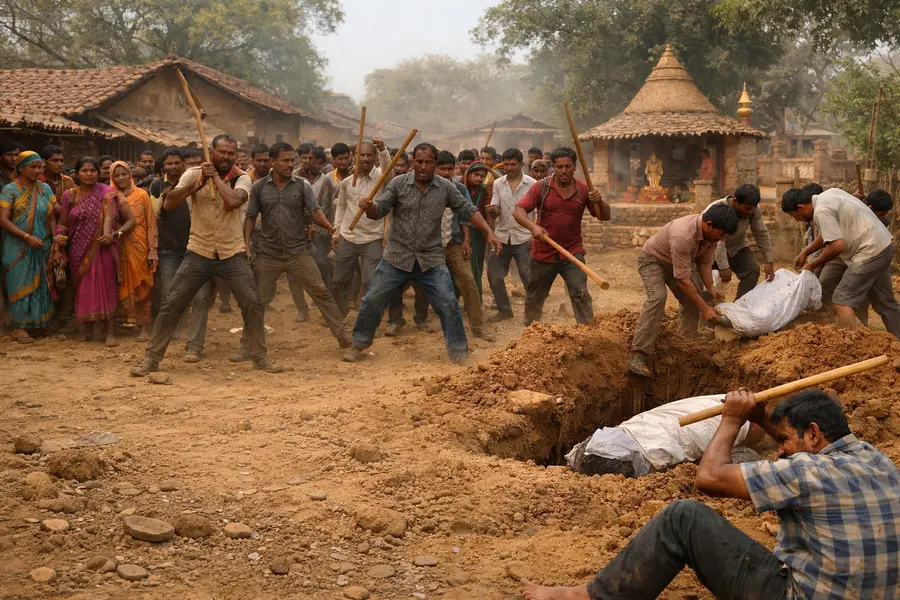
Representative image created using AI
In Kanker district in Chattisgarh, tribal Christians faced violence after the burial of the elected Sarpanch Rajman Salam’s father according to Christian rites. A mob attacked villagers and clashed with police, citing religious and local land claims, raising serious concerns about law and order and minority rights.
On 15 December 2025, the father of Rajman Salam, the elected Sarpanch, was buried in Bade Tevda (Amabeda) in Kanker district, in accordance with Christian rites. After the burial, a large mob led by Sukdu Ram began inciting villagers, falsely claiming that under the PESA Act, they had the right to exhume the body. The mob asserted that the land belonged to a local deity and that a Christian burial was impermissible, constituting an insult to the deity.
Videos from the site show mobs assaulting Christian tribals with lathis and even manhandling police personnel, highlighting a complete breakdown of law and order. RSS-affiliated groups reportedly threatened to return on 18 December in larger numbers. The incident falls within the Kanker Lok Sabha constituency, represented by MP Bhojraj Nag, raising serious questions about local administrative complicity and the broader climate of impunity.
Selective Misuse of Supreme Court Verdict
The situation has been aggravated by the selective citation of the Supreme Court’s January 2025 split verdict in the Ramesh Baghel burial case from Bastar. Locally, this ruling is being misused to justify violence, enforce religious conformity, and intimidate Christian communities. The law, in this case, is weaponized by majoritarian actors to assert dominance rather than to protect rights.
This constitutes a violation of Article 21 of the Constitution, which guarantees the right to dignity even after death. In Parmanand Katara v. Union of India, the Supreme Court affirmed that the State has a duty to ensure that deceased individuals are treated with respect and accorded burial according to their faith. The Kanker incident highlights a systemic failure to uphold these constitutional guarantees.
Domestic Majoritarianism and the Conditional Citizen
The assault on Sarpanch Rajman Salam and his family reflects a growing pattern of majoritarianism, where constitutional rights are applied selectively and citizens’ safety is conditioned on religious identity. Tribal Christians and other minority communities increasingly face harassment, threats, and violence, often with state complicity or inaction.
This conditionality extends beyond isolated attacks. Laws like the Citizenship Amendment Act (CAA) and the selective application of the National Register of Citizens (NRC) create hierarchies of belonging. Citizens are divided into two classes: those aligned with the majority ideology, and those whose very existence is subject to scrutiny. Majoritarianism is no longer just social or cultural—it is legal, institutional, and political.
Preventive detention, colonial-era sedition laws, and the Unlawful Activities (Prevention) Act (UAPA) are routinely used to suppress dissent. Activists, journalists, and elected representatives like Sarpanch Rajman Salam are targeted, sending a message that law enforcement can be wielded selectively to enforce ideological conformity.
Anti-Christian Persecution in Context
Christian communities in central and northeastern India have faced a sustained campaign of harassment. This hate campaign has included:
• Vandalism of churches and attacks on clergy
• False accusations of forced conversions
• Obstruction of religious rites, including burials and weddings
The Kanker incident is a continuation of this trend, showing how religious intolerance has been normalized and institutionalized. The threat of recurring mob violence, reinforced by ideological organizations, creates a climate of fear that suppresses rights and undermines democracy.
Human Rights and International Law
The failure to protect minorities has both domestic and international implications. Human rights are universal, not privileges granted by the majority. The assault on tribal Christians in Kanker violates:
• Article 21 (right to life and dignity)
• Articles 14–15 (right to equality and non-discrimination)
• Articles 19 and 25 (freedom of expression, assembly, and religion)
India is also party to international treaties and conventions, including the International Covenant on Civil and Political Rights (ICCPR), which obliges the State to protect the rights of minorities. Selective enforcement of law and the tacit tolerance of mob violence erode India’s credibility on the global stage and weaken the moral authority of its democratic institutions.
Domestic Majoritarianism Mirrors International Alignments
Domestically, the BJP-led state is promoting a majoritarian ideology through law, policy, and selective enforcement. Internationally, similar patterns emerge. India’s ongoing Free Trade Agreement (FTA) negotiations with Israel, a state accused of systemic discrimination and apartheid against Palestinians, underscore a willingness to align economically and strategically with regimes that violate human rights.
While proponents emphasize economic gains—technology transfer, trade in goods and services, defense cooperation—the ethical cost is high. Normalizing relations with a state accused of apartheid mirrors domestic patterns of selective law enforcement, suggesting a consistent prioritization of majoritarian power over justice.
Legal and Moral Responsibility
The Kanker incident, when read alongside international alignments, highlights the dual failure of the State.
The BJP’s political trajectory is clear: majoritarianism enforced through law, fear, and selective impunity. The consequences are not hypothetical. Citizens—especially minorities—face harassment, violence, and systemic discrimination; democracy itself is weakened; and India’s moral and legal credibility internationally is diminished.
A Strong caution to the BJP from the perspective of law
The Kanker case serves as a stark warning:
Law cannot be selectively applied. Article 21 guarantees dignity; Articles 14–15 guarantee equality. These rights are not negotiable.
Citizenship and legal protection cannot be conditional. Targeting elected representatives and ordinary citizens based on religious identity undermines the Constitution.
Economic pragmatism cannot replace moral responsibility. Deepening ties with states accused of systemic human-rights violations signals complicity and normalizes oppression.
Ignoring these warnings risks domestic unrest, international censure, and long-term erosion of India’s democratic fabric. Violence against minorities is not merely a local problem; it reflects systemic failures that require urgent redress.
The Imperative of Action
The State must take immediate, decisive action to protect minority communities and ensure the security of citizens performing lawful religious practices. It must also ensure that constitutional guarantees are enforced impartially, with no tolerance for selective law enforcement. The State should hold ideological organizations accountable for inciting violence, regardless of affiliation or influence.
More importantly, the State should reassess foreign policy decisions to ensure alignment with international human-rights obligations and ethical governance.
After all, democracy is measured not by the frequency of elections or trade agreements, but by the universality of rights, impartiality of law, and dignity accorded to citizens. Majoritarianism unchecked—whether through law, violence, or foreign policy—erodes every element of that democracy.
Going forward
The assault on Sarpanch Rajman Salam is not an isolated incident. It is part of a broader strategy of targeting minorities and undermining constitutional rights. Ensuring impartial enforcement of the law and protecting citizens’ rights, including the freedom to practice religion, is crucial to preserving democracy. Coupled with ethically questionable foreign policy decisions, such as the FTA with Israel, it signals a disturbing trajectory: the institutionalization of selective justice, both at home and abroad.
India stands at a moral and constitutional crossroads. Upholding human rights, enforcing the law impartially, and ensuring that democracy functions as intended is non-negotiable. Silence, inaction, or complicity will only embolden majoritarian actors, undermine constitutional guarantees, and weaken India’s legitimacy in the world.
The Kanker incident and the larger patterns it reflects are a warning - urgent, undeniable, and actionable. Democracy, law, and human rights cannot wait.
(By Ranjan Solomon, political commentator and advocate for robust inter-religious living)
Tags



Related News
Dont Miss it










0 comments