
Central Trade Unions Call Nationwide General Strike on February 12 Against Labour Codes
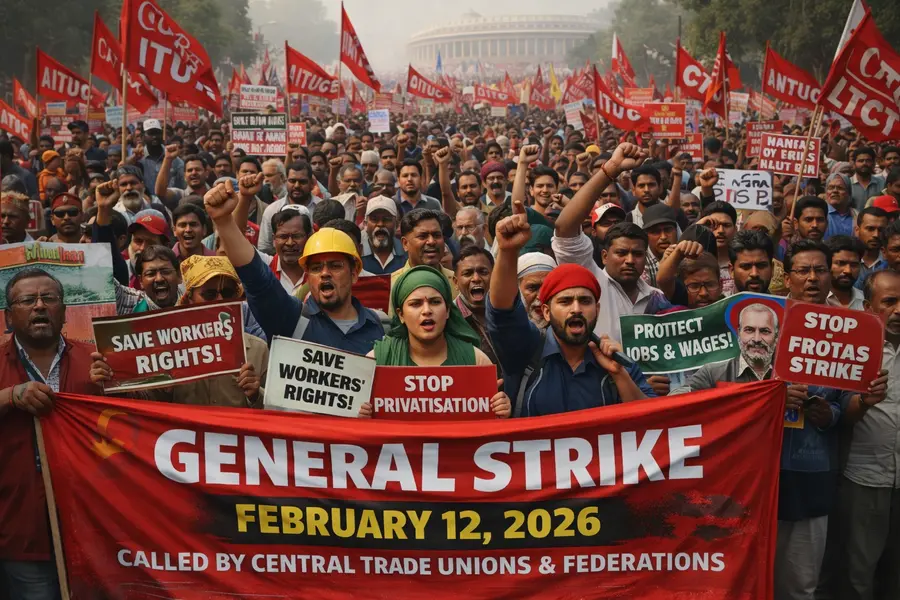
Representative image created using AI
New Delhi: A joint platform of Central Trade Unions (CTUs) and several sectoral federations and associations on Tuesday announced their decision to call a nationwide general strike on February 12, 2026, protesting against the Centre’s labour codes, which are widely considered as a “multi-pronged attack” on workers’ rights and people’s entitlements.
The decision was taken at a meeting of the Joint Platform of Central Trade Unions and Sectoral Federations/Associations held on Monday. The unions said the strike date would be formally ratified at a National Workers’ Convention scheduled for January 9, 2026, at HKS Surjeet Bhawan in New Delhi.
In a statement issued to the press, the trade unions accused the Modi government of pushing through major policy changes inside and outside Parliament that they claim undermine labour rights, federalism, environmental protection and public sector interests.
Among the key concerns flagged was the recently introduced Sustainable Harnessing and Advancement of Nuclear Energy for Transforming India (SHANTI) Act. The unions alleged that the Act allows private and foreign companies to enter nuclear power generation while diluting supplier liability provisions in case of accidents, posing risks to nuclear safety and national sovereignty.
The CTUs also criticised the replacement of the Mahatma Gandhi National Rural Employment Guarantee Act (MGNREGA) with the Viksit Bharat – Guarantee for Rozgar and Ajeevika Mission (Gramin) Act, 2025. According to them, the new legislation does away with the rights-based framework of guaranteed rural employment, shifts the financial burden to states, and restricts employment during harvesting seasons, which they said would adversely impact rural workers.
Other issues raised included the government’s decision to allow 100 per cent foreign direct investment in the insurance sector, the introduction of the Viksit Bharat Shiksha Adhishthan Bill, 2025, and the proposed Draft Seed Bill and Electricity (Amendment) Bill, 2025. The unions warned that these measures could harm farmers, MSMEs, domestic electricity consumers and public sector undertakings.
The meeting also expressed concern over environmental issues, including severe air pollution in Delhi-NCR and a recent Supreme Court order permitting large-scale destruction of the Aravalli Hills, which the press release described as ecologically dangerous.
The Joint Platform extended solidarity to various people’s movements opposing these policies and acknowledged the support of the Samyukta Kisan Morcha (SKM), which has backed the proposed general strike. The National Coordination Committee of Electricity Employees and Engineers (NCCOEEE) has announced a sectoral national strike on the same day.
The unions said nationwide protests against the SHANTI Act would be held on December 23, 2025, while joint conventions involving electricity employees and consumers would take place in January and February. The SKM has also announced a “Resistance Day” on January 16, 2026, at village and block levels against the proposed Seed Bill, Electricity Amendment Bill and the new rural employment law, with participation from trade unions.
Reiterating their opposition to the four labour codes that have already been notified, the CTUs alleged that the government is attempting to build public consensus through institutional mechanisms and media outreach. They warned that if the government proceeds with framing rules under the codes without repealing them, the unions may escalate their agitation, including multi-day general strikes and sector-specific actions.
Calling upon workers, farmers, youth, students and opposition political parties to support the proposed strike, the CTUs said the movement was aimed at defending basic labour rights and safeguarding the democratic fabric of the country.



Related News
Dont Miss it









0 comments