
The Power Shock: Uttar Pradesh’s Struggle Against Privatization

Varkey Parakkal
Published on Apr 08, 2025, 11:03 PM | 4 min read
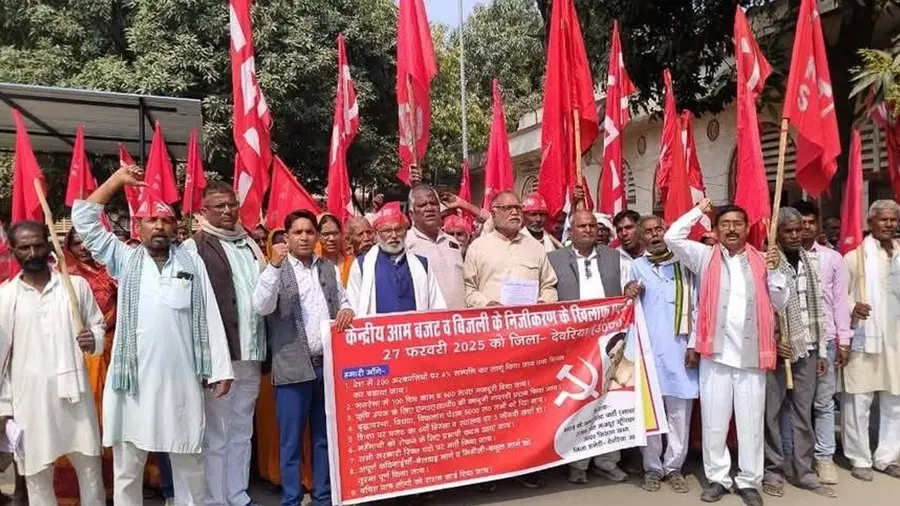
Uttar Pradesh: Employees of the Purvanchal (PUVVNL) and Dakshinanchal (DVVNL) state-run electricity distribution companies under the Uttar Pradesh Power Corporation Ltd have been protesting for the past three months against the RSS-BJP led Yogi Adityanath government's ongoing push towards privatization. The Electricity Employees Federation of India (EEFI) has stated that this move threatens the jobs of 27,000 employees and 50,000 contract workers, while also leading to rising tariffs. Earlier this year, UP power employees' unions picketed the government's pre-bidding event.
What began as a localized struggle has now evolved into a statewide movement, garnering support from trade unions, farmers' unions, and the broader working class. Agricultural organizations backing the protest argue that rising tariffs due to privatization will exacerbate agrarian distress and increase the cost of living. For context, in Mumbai—where two major private companies supply electricity—domestic consumers pay Rs. 17-18 per unit, significantly higher than Uttar Pradesh's highest domestic rate of Rs. 6.50 per unit.
The UP government has also pressed ahead with plans to sell two 800 MW power generation units and its transmission assets in Anpara and Obra to private players, despite widespread opposition from workers and other stakeholders. The National Coordination Committee of Electricity Employees & Engineers (NCCOEEE) has reported that the government’s response to striking workers includes repressive measures, extending even to the families of employees. The unions also point out that the Essential Services Maintenance Act (ESMA) has been in effect in Uttar Pradesh for over a decade, curbing the democratic rights of government employees in sectors classified as essential services.
The EEFI has stated that the situation in UP is part of a nationwide attack on public amenities and a threat to energy security. Chandigarh recently privatized its power grid despite ongoing opposition. Previously, the Chandigarh UT Power Department was a profitable enterprise, with margins of up to Rs. 365 crore in 2019-20, Rs. 225 crore in 2021, and Rs. 261 crore in 2021-22. Meanwhile, the utility tariff remains around Rs. 4.50—one of the lowest in the country. The unions argue that the privatization process lacks transparency and is characterized by the deliberate undervaluation of well-managed public utilities.
Since the neoliberal shift in 1991, there have been several attempts to privatize the electricity grid. Initial reforms aimed to replicate the World Bank’s “Independent Regulatory Agency” model, which advocated for the unbundling of vertically integrated State Electricity Boards and encouraged private sector participation. Proponents claimed that private involvement would boost competition and efficiency. Orissa became the first state to privatize in 1996, but this led to deteriorating service quality, higher tariffs, and financial distress for utilities, forcing state intervention. Despite this history, Orissa re-privatized its distribution companies in 2020.
The early 2000s saw the passage of the Electricity Act of 2003, accelerating the privatization trend by promoting private transmission and distribution, paving the way for the current push toward full privatization.
In this context, the Central government introduced the Electricity Amendment Bill in 2022, which sparked strong opposition from unions nationwide. The bill seeks to further privatize electricity distribution, with critics arguing that it will dismantle public infrastructure and push state-run power utilities into crisis. The amendment represents the final step in a process that allows private companies to enter the distribution sector without any obligation to serve unprofitable areas. This could lead to cherry-picking profitable urban markets while leaving loss-making rural areas underfunded, worsening disparities in access.
Globally, neoliberal privatization of state energy sectors has led to higher tariffs without delivering the promised efficiency gains. The UK’s electricity privatization in the 1980s resulted in higher bills and energy poverty, forcing the government to introduce subsidies for low-income households. Similarly, Argentina’s privatized power sector collapsed during its economic crisis, prompting a return to state control. Germany has also witnessed a wave of re-municipalization, with local governments reclaiming electricity distribution due to public dissatisfaction with private management.
Over the years, economists have warned that privatization undermines the constitutional commitment to equality by turning public amenities into commodities and increasing inequality. Thinkers like Noam Chomsky argue that the standard efficiency criteria for basic services are fundamentally flawed. When applied to essential amenities, these measures prioritize cost-cutting and profit over human needs. In such cases, accessibility should take precedence, even if services operate at a loss.
The NCCOEEE has called for a nationwide strike on June 26, 2025, against the Union government’s privatization of India’s power sector. With an expected turnout of 2.7 million electricity employees and engineers, along with solidarity from other trade and farmers' unions, it is poised to become the largest sectoral protest in decades.



Related News
Dont Miss it








0 comments