

Kerala Cabinet Gives In-Principle Nod to High-Speed RRTS Corridor from Thiruvananthapuram to Kasargod
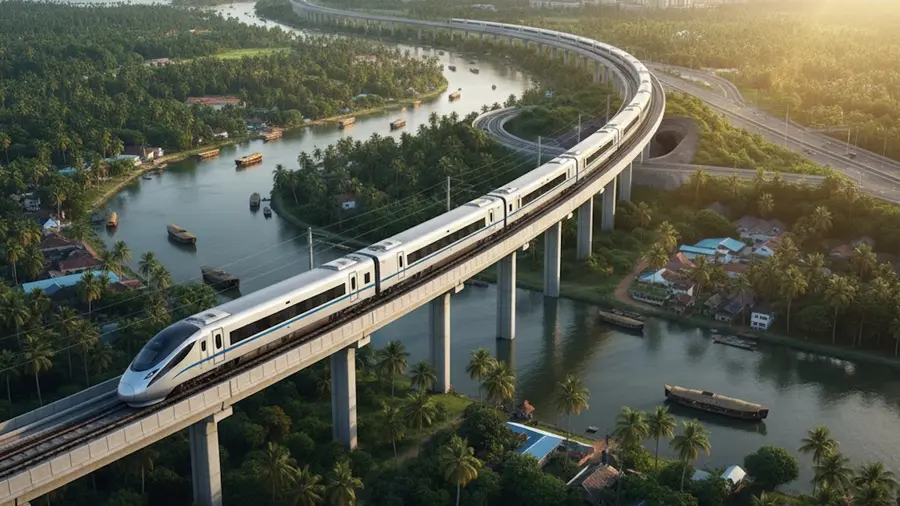
Thiruvananthapuram: The Kerala Cabinet has given in-principle approval to implement the Regional Rapid Transit System (RRTS) project, aimed at bringing a revolutionary transformation to the state’s transport sector. The state government will officially inform the Union government of its interest in implementing the project along a 583-kilometre corridor from Thiruvananthapuram to Kasargod. The Transport Department has been tasked with initiating preliminary discussions in this regard. The move follows the Centre’s stated position that the project can be seriously considered once a Detailed Project Report (DPR) is submitted.
Modeled on the Delhi–Meerut corridor, RRTS trains will be capable of operating at speeds of 160 to 180 km per hour. Taking into account Kerala’s high population density and unique geography, the corridor is envisaged as a grade-separated alignment, primarily running on elevated pillars, with tunnels used wherever necessary. This design is expected to significantly reduce land acquisition requirements and prevent disruption to natural water flow. RRTS stations will be integrated with the Kochi Metro and the proposed Thiruvananthapuram and Kozhikode Metro systems. Financing will follow the Delhi model, with 20 percent each contributed by the state and central governments, and the remaining 60 percent sourced through international loans.
The project is planned to be completed in four phases, with the target of making the system operational by 2033. In the first phase, construction of the 284-kilometre stretch from Thiruvananthapuram to Thrissur is scheduled to begin in 2027, alongside the implementation of the Thiruvananthapuram Metro and integration with the Kochi Metro. The second phase will extend the line to Kozhikode, the third phase to Kannur, and the final phase to Kasargod. There are also plans to expand the network in the future, in cooperation with neighboring states, to Coimbatore, Kanyakumari, and Mangaluru.
The government’s shift toward RRTS comes in the backdrop of the SilverLine project facing setbacks due to the lack of technical approval from the Railways and resistance including public opposition. Railway recommendations were also seen as misaligned with the state’s development goals, contributing to the SilverLine impasse. Once in-principle approval from the Centre is obtained, the Transport Department will proceed with memoranda of understanding and submit a detailed report to the Cabinet for final decisions on financial and technical aspects.



Related News
Dont Miss it










0 comments