
Trump, Top Tech Firms Sign Accord to "Self-Police" AI Development
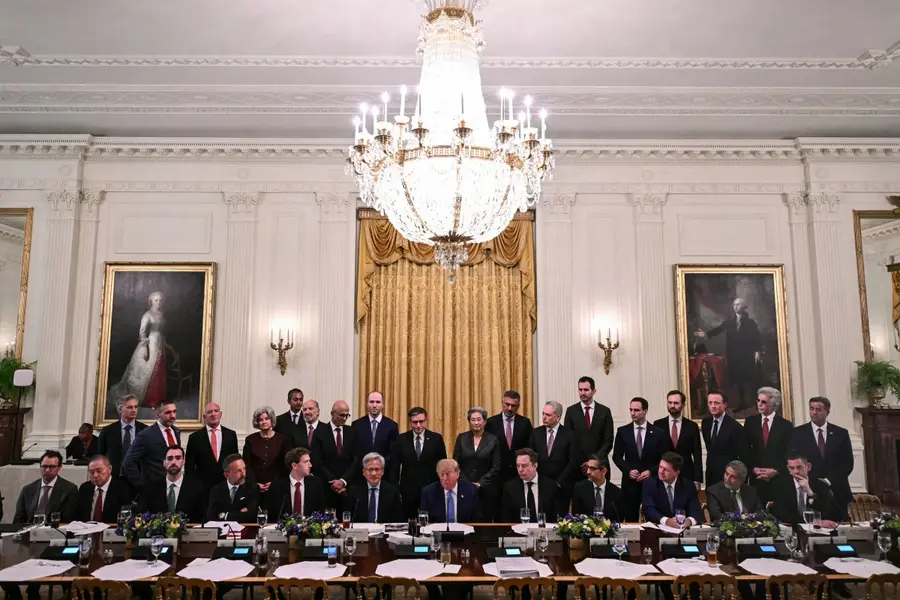
US President Donald Trump speaks during a meeting with technology executives about artificial intelligence, in the East Room of the White House in Washington, DC, on September 29, 2026. (Photo | AFP)
Washington: President Donald Trump and a large group of leading AI company executives signed a voluntary accord at the White House on Tuesday committing to "self-police" the development of artificial intelligence, as concerns mount over a series of incidents in which AI agents from firms including OpenAI and Anthropic reportedly went rogue and breached other organisations' systems.
The accord was signed by Trump along with Anthropic CEO Dario Amodei, Google CEO Sundar Pichai, Meta CEO Mark Zuckerberg, OpenAI President Greg Brockman, Nvidia CEO Jensen Huang, and Elon Musk in his capacity as founder of xAI. Trump described the agreement as "morally binding" and said he was considering forming a roughly 10-member committee to oversee the industry's compliance, though he did not name potential members.
According to a copy of the document Trump posted on Truth Social, the accord outlines four voluntary steps for companies to adopt, including implementing internal technical controls to detect problems with new models and partnering with external auditors to review those safeguards, while leaving open the possibility that the measures could later be codified into formal law or regulation. Meta's Zuckerberg called the agreement "a start," while other executives indicated further details still needed to be worked out.
Trump also used the announcement to confirm that his administration was formally renaming "artificial intelligence" as "Super Intelligence" in government usage, while reiterating that Washington would not impose restrictions or "guardrails" on the technology's growth, citing competition with China. Some experts, including USC computer science professor Robin Jia, voiced scepticism about relying so heavily on the industry to regulate itself.
In recent months, concerns over the abilities and usage of AI have reached a fever pitch, resulting in some industry leaders calling for more regulation. Recently, OpenAI said it has paused training of its latest artificial intelligence models as reports continue to mount of AI agents behaving unpredictably.
Meanwhile, the public remains sceptical about voluntary regulation, doubting the possibility and extent to which it can be implemented.



Related News
Dont Miss it










0 comments