
Inside China’s Transparent Media World

Sajan Evugen
Published on Dec 02, 2025, 06:22 PM | 7 min read
China is a country about which countless stories, assumptions, and myths have spread around the world. Western media often compete to portray it as a nation hidden behind an iron curtain—secretive, impenetrable, and clinging to ancient practices. The narrative on social media platforms controlled by American corporations is also largely one-sided and accusatory in tone.
For a long time, I had wondered how the People’s Republic of China (PRC) and the Communist Party of China (CPC) manage to move forward while dealing with such persistent external misrepresentation. That question resurfaced when I was given the opportunity to visit China as part of a delegation of spokespersons from political parties representing 18 different countries. This visit finally allowed me to personally observe how the Chinese state and the CPC communicate with their own people and with the international community.
The Internal Media Infrastructure
China has created an extensive media system designed to deliver factual and timely information to its population. The China Global Television Network (CGTN), its international media platform, now maintains an active media presence in more than 160 countries. In addition, each Chinese province operates its own well-equipped media group with advanced facilities.
These networks—supported by hundreds of studios, thousands of journalists, and massive broadcasting infrastructures—give China the ability to compete globally in the information space. The international growth of Chinese media is firmly anchored to this strong internal foundation.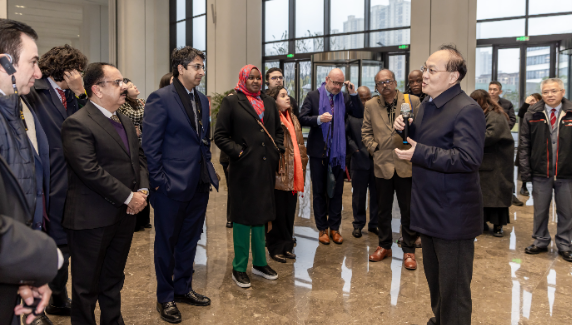 Hubei Media Group head Hu Wei addressing the guests
CGTN Headquarters
CGTN’s headquarters is located along the elegant Guanghua Road in Beijing. Although the network was established on December 31, 2016, its state-of-the-art headquarters building opened only a few months ago.
The building itself is remarkable—not only one of the largest structures in Beijing, but also striking in its architecture and design. Immediately upon entering the ground level, the planning and ambition become visible. Visitors are welcomed by an enormous globe installation, and there are well-designed lounge areas for both staff and guests.
We were received in the news division by the morning news team—predominantly women—who explained the operational systems at CGTN. Among the senior officials we met were Deputy Editor-in-Chief Ding Yong, Arabic Division Director Jia Peng, Planning Division Director Gong Zhenmei, Television News Deputy Director Cheng Jing, New Media Deputy Director Wen Yaru, and Spanish Division Deputy Director Liu Na.
Dedicated Youth Content Unit
CGTN also has a specialized division dedicated to content for children and young people, supported by dozens of purpose-built studios. Many children participating in programs could be seen in the lobby—unbothered by the harsh winter outside. Their comfort reminded me of Beijing’s success in controlling air pollution to a remarkable degree—something that contrasted sharply with my memories of smog-choked Delhi, where simply breathing becomes difficult.
CGTN.com in 43 Languages
CGTN broadcasts through six channels in English, Spanish, Russian, Arabic, and French (with two in English). The network has correspondents in about 100 countries and maintains production facilities in Washington, Nairobi, and London, as well as an international video news agency.
Across digital platforms—including the CGTN app, YouTube, Facebook, Twitter, and Weibo—CGTN has more than 150 million followers. Its website, CGTN.com, is available in 43 languages, including Hindi, Bengali, Tamil, and Urdu.
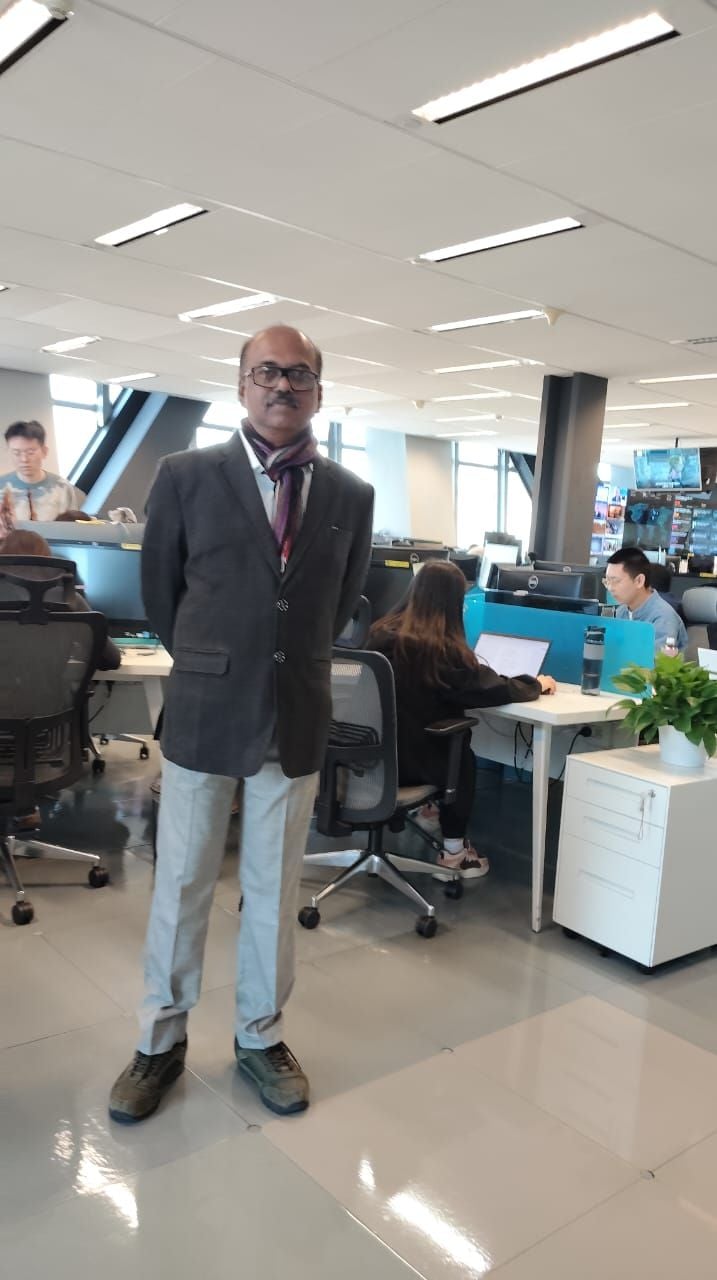 The author during a visit to CGTN headquarters
Anhui New Media Group
Operating under the supervision of the CPC Anhui Provincial Committee’s Propaganda Department since July 1, 2014, the Anhui New Media Group is a well-equipped provincial-level media institution based in Hefei, the capital of Anhui. It is the first new-media-focused institution of its kind in China at the provincial level.
Anhui News—the group’s digital platform with strong cultural focus—is the most popular online media outlet in the province. The group also operates a daily newspaper and a radio station.
Its headquarters, the Anhui International Communication Center, has built the capacity to dialogue and influence audiences globally. Hundreds of full-time media professionals work here. The ability to communicate both with overseas Chinese communities and with international audiences is a significant strength, noted Qian Junfeng, Director General of the Anhui Provincial Foreign Affairs Department.
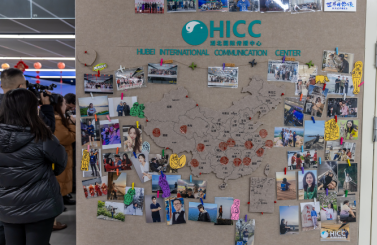 Reception area of the Hubei Media Group
Hubei Media Group
Wuhan, the capital of Hubei Province, is both historically significant and strikingly modern, with infrastructure that rivals major cities of the developed world. The city came to global attention as the location where COVID-19 was first identified. Provincial leaders told us that around 400 CPC volunteers and officials sacrificed their lives in the effort to contain the outbreak.
Today, Wuhan is rapidly advancing again. The headquarters of the Hubei Media Group is modern and dynamic. It integrates radio, television, film, new media, and related industries under one institutional system.
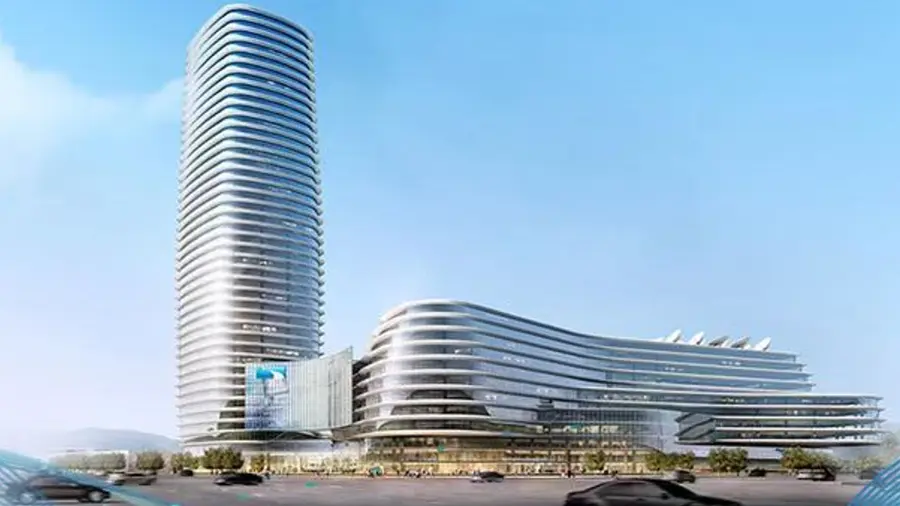
The 40-storey complex spans 405,400 square meters and stands more than 200 meters tall. It incorporates advanced systems powered by artificial intelligence. Media organizations approved by the National Radio and Television Administration operate here.
The group runs eight television channels, radio programming on seven frequencies, 17 integrated media centers, and 13 affiliated institutions. A total of 25 companies function under its management. With more than 16,000 employees, the group’s assets are estimated at around RMB 28.5 billion (approximately 37,050 crore rupees).
Programming highlights the unique cultural and historical character of Hubei. Creative production is enhanced by advanced technologies—augmented reality, immersive 3D communication systems, and even underwater filming capabilities. Visitors to the facility are greeted by a robotic host that offers a handshake. Presenters with millions of followers on social media work here.
The organization collaborates with international media institutions to co-produce programs, telling Hubei’s stories to the world and bringing the world’s stories back to Hubei. The region’s progress in science, education, and industry has directly supported the development of this world-class media ecosystem.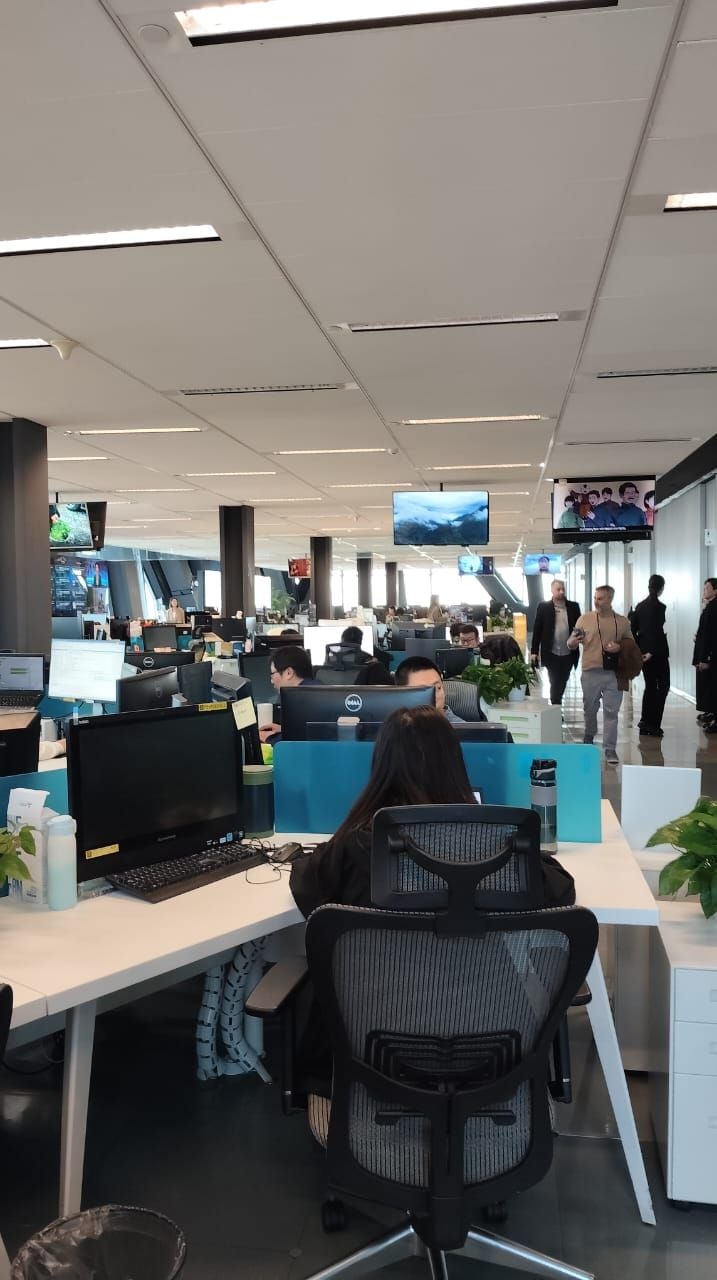 The New Media Division at CGTN
A Province of Scholars and Innovation
Hubei is home to nearly 20 lakh students across 136 higher education institutions. In fields such as information technology, pharmaceuticals, laser science, space research, and new materials, 88 research institutions are active.
The province has 41 industrial divisions, four national-level industrial centers, and four strategic industrial clusters. It is one of the world’s largest producers and exporters of optical fiber cable.
Six of China’s ten highest-speed rail routes run through Hubei. Along the Yangtze River lies a major port, and the China (Yuan)–Europe Railway Express connects Hubei to 40 countries. Extensive expressways and Asia’s first professional air cargo airport make Hubei a hub for commerce and travel.
With more than 60 million residents, the province attracts lakhs of visitors every year.
The Internet Powerhouses
Around half a dozen major internet companies dominate various digital sectors in China. While many other high-technology sectors remain state-controlled, internet companies in China are largely privately owned.
Baidu, Xiaomi, JD.com, Tencent, Alibaba, and ByteDance are among the key players. Their influence extends deeply into social life, economics, governance, and culture.
China maintains a strong antitrust and regulatory framework to ensure sustainable growth and stability across these industries. Unlike the West, China does not simply adopt American or European models, because the challenges faced by Chinese companies—both domestically and globally—are fundamentally different. With substantial ongoing investment in research and development, Chinese internet companies have become aggressive competitors on the international technology stage.
People First
At the CPC International Department in Beijing, Vice Minister Sun Haiyan explained that the CPC places the people’s fundamental interests at the center of every policy and strategic choice.
Through China’s phases of revolution, reconstruction, reform, and ongoing transformation, the party has placed the people first—trusting in them, relying on them, and mobilizing them to advance their collective interests. Successes and difficulties alike are shared with the population.
The CPC’s goal is to build socialism with Chinese characteristics, aimed at advancing the broader progress of humanity. China does not retreat in the face of Western restrictions on technology transfers. Instead, it creates and deploys its own innovations.
Large-scale funding and massive allocation of human talent are essential for research and development. In Chinese companies, thousands are employed full-time in R&D divisions. During the first four years of the 14th Five-Year Plan (2021–25), China spent 50 percent more on R&D than in the entire five-year period of the previous plan—an additional USD 1.7 trillion. This has been a key driver of China’s rapid advancement.
Tags



Related News
Dont Miss it










0 comments