
The Seventh Party Congress: The Formation of CPI(M)

Research Desk
Published on Mar 25, 2025, 06:47 PM | 5 min read
The ideological and organizational differences within the Communist Party grew more pronounced after the Sixth Congress—often referred to as the "Congress of Compromises." Following the demise of Ajoy Ghosh, the party's National Council convened in May 1962 to elect a new General Secretary and evaluate the results of the 1962 general elections. However, the council failed to reach a unanimous stance. Two separate reports—one by P.C. Joshi and another by Bhupesh Gupta—were presented before the council regarding the election outcome. Since there was uncertainty regarding whether the revisionist group would gain a majority in the National Council, the adoption of the report was postponed. Due to the disagreements in electing a new secretary, a new position of chairman, which was not in the party's constitution, was created to reach a consensus. S.A. Dange was elected as Chairman, and E.M.S. Namboodiripad became the General Secretary. A new Secretariat was formed as well.
Amidst this, the India-China border dispute intensified significantly. The Chinese army crossed into Indian territory, and the issue of China had a profound impact within the party. Media reports created the impression that the chairman and the general secretary were on opposing sides. The ruling authorities, supported by the revisionist faction led by Dange, labeled leftist intellectuals within the party as Chinese agents and targeted them harshly. Party leaders and activists across the country were hunted down, arrested, and imprisoned. Even General Secretary E. M. S. Namboodiripad was briefly detained but was later released. Rather than negotiating for his release, the Dange group concentrated on consolidating its majority in the National Council. This bitter internal conflict culminated in April 1964 when 32 members walked out of a critical council meeting. On April 14, they issued a comprehensive statement, detailing the circumstances that led to their dramatic departure.
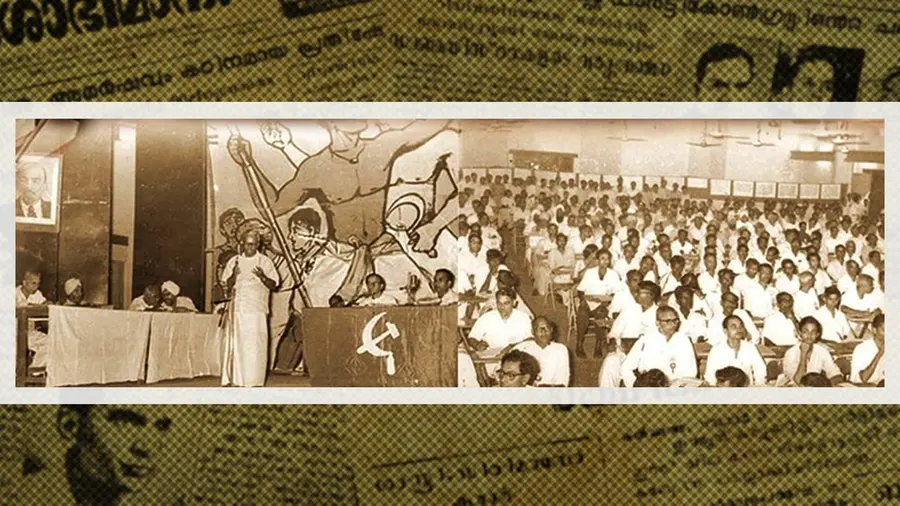
From July 7 to 11, 1964, a significant convention was held in Tenali, Andhra Pradesh. 146 representatives, representing over one lakh party members, gathered for the event. State committees presented detailed reports, critiquing revisionist political ideologies, exposing actions that had divided the party, and revealing the internal dynamics within each region. After extensive discussions on political and ideological issues, it was decided to convene the seventh party congress in Kolkata. The agenda and key decisions for the congress were finalized, and based on this, the seventh party congress took place in Kolkata from October 31 to November 7, 1964.
The seventh Congress was attended by 422 delegates, representing 1,04,421 party members, nearly 60% of the party members from the Vijayawada Congress of 1961. It was at the seventh Congress that the Communist Party of India (Marxist) (CPI(M)) was formed. The Congress adopted the party program.
The fight against the revisionist faction – Political-Organisational Report
The political-organizational report opens by stating that the Seventh Party Congress would be remembered as the pivotal moment when the Indian communist movement finally liberated itself from the long-held constraints of revisionism and class collaboration. Despite efforts within the party to prevent this shift, the revisionists gained dominance in November 1962, adopting bourgeois organizational methods and attempting to impose them on the party. The resolution emphasizes how every attempt to steer Dange's faction away from their anti-party stance had failed, leaving no option but their removal and the convening of this extraordinary Congress. With profound historical awareness, the document addresses both the internal party issues that arose after 1945 and the differing viewpoints on the international stage.
The discussions addressed topics such as the evaluation of the general elections, the party's organizational situation, the pivotal meeting of the National Council (October–November 1962), the international context, the organizational policy of the right-wing-dominated National Council, our party's efforts to restore internal unity, and the crisis related to foreign sources and planning.
The Political Resolution adopted at the Seventh Party Congress clearly defined the party's responsibilities during that critical period. It observed that the government, while actively promoting bourgeois capital and accommodating foreign investment, had neglected to implement meaningful land reforms to support peasants, agricultural workers, tenant farmers, and small-scale cultivators—deepening the nation's political and economic crises. In this situation, the Communist Party and its class-mass organizations critically examined their weaknesses and resolved to rally the people for organized resistance. To achieve this, the party needed to strengthen itself on the firm ideological foundation of Marxism-Leninism. The resolution emphasized the necessity of continuing the struggle against revisionist tendencies while steadfastly upholding working-class principles—a commitment firmly endorsed by the Party Congress.
The Party Congress also adopted a special resolution declaring that the delegates attending this Congress truly represented the Indian Communist Party, and that the Dange group had no legitimate claim to identify itself as the CPI. Additionally, amendments to the party constitution were approved.
A 31-member Central Committee was elected, with six positions left vacant for future co-option. P. Sundarayya was chosen as the General Secretary. On November 8, 1964, the newly formed Central Committee elected a nine-member Politburo and appointed three members to the Control Commission.
Members of the Politburo:
P. Sundarayya (General Secretary)
E. M. S.
A. K. Gopalan
M. Basava Punnayya
Pramod Das Gupta
Jyoti Basu
P. Ramamoorthy
Harkishan Singh Surjit
B. T. Randive



Related News
Dont Miss it








0 comments