

The First Party Congress: A Historic Gathering Under the Red Flag in Mumbai
T Chandramohan
Published on Mar 19, 2025, 05:40 PM | 6 min read
The CPI(M) is actively preparing for its 24th Party Congress in Tamil Nadu, set to take place in Madurai from April 2nd to 6th. This event will focus on critical discussions and decisions aimed at shaping India's political future. In this context, Deshabhimani Online is set to publish a serialized history of the 23 previous Party Congresses, highlighting the crucial decisions that have shaped the party’s course.
The Indian Communist Party was formed on October 17, 1920, in Tashkent. Following this, numerous communist groups emerged and began operating across different regions of India. Among these, the groups led by S.A. Dange in Bombay, Muzaffar Ahmed in Calcutta, M. Singaravelu Chettiar in Madras, and Ghulam Hussain in Lahore were particularly significant. The Communist Party of India played a crucial role in training these groups in Marxist-Leninist ideology, both theoretically and practically. The establishment of the Communist Party in India was marked by a conference held in Kanpur on December 26, 1925. It took 23 years after its initial formation in Tashkent to unify the diverse communist groups active across the nation and convene the first Party Congress.
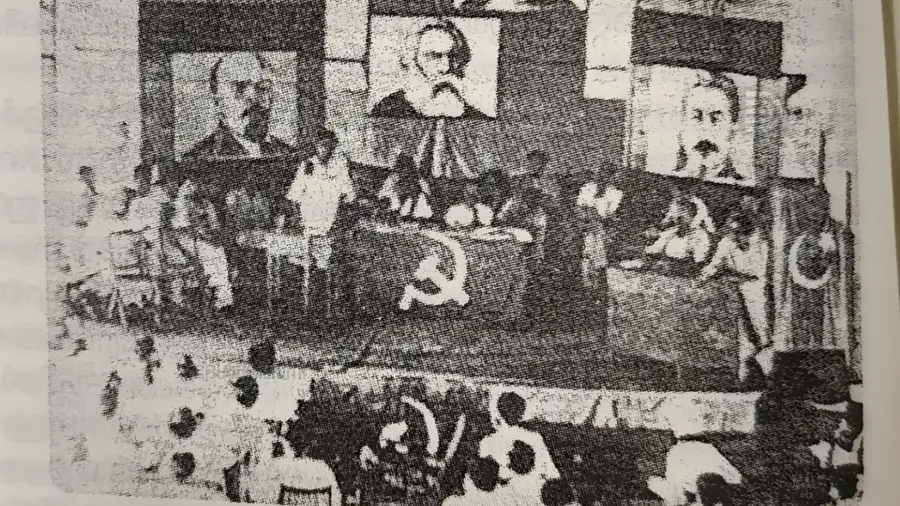
The first Party Congress took place in Mumbai from May 23 to June 1, 1943. The Congress took place at the R.M. Bhatt School Hall near Kamgar Maidan, with 139 delegates participating. The Congress convened during a critical period marked by the Quit India Movement and the Second World War. On one hand, there was widespread support for the anti-fascist alliance, which included the Soviet Union and China, while on the other, there was deep anger toward the British rulers, who were suppressing the Indian people and denying the demand for national independence. This tension between the two perspectives sparked intense debates within the party. Additionally, the Congress addressed the formalization of inner-party democracy, laying the groundwork for the party's future direction and strengthening its internal democratic processes.
The political resolution presented by P.C. Joshi lasted for nine hours. The report highlighted the grave dangers posed by Japan's invasion and the rising internal challenges within the country. Politburo member B.T. Ranadive delivered a report on the responsibilities of the working class and the importance of national resistance in the context of the People's War. Provincial secretaries provided detailed accounts of their activities and shared insights gained from their regional experiences. S.G. Sardesai addressed issues related to food security, while E.M.S. focused on strategies to boost food grain production. Arun Bose discussed matters pertaining to students. Additionally, reports were presented on women's issues and the children's movement (Balasangam). The party’s new constitution was introduced by G. Adhikari.
The Party Congress took place two months after the Kayyur martyrdom. A resolution honoring the Kayyur martyrs was presented at the Congress. Kelu Nair, the brother of martyr Podora Kunjambu Nair and the Kayyur cell secretary, commemorated the Kayyur martyrs. Bishwanath Mukherjee presented a resolution regarding comrades enduring imprisonment. The resolution also highlighted the contributions of K.P.R. Gopalan, a prominent leader of the Malabar struggle, and other courageous fighters of the Malabar peasant movement and comrades from Mattannur, Kayyur, and Morazha.
The Congress extended its salutations to the Red Army and the Dutch forces. A resolution expressing respect for the Indian Army and the Navy was presented by Somnath Lahiri, while B.T. Ranadive introduced a resolution concerning the dissolution of the Communist International. The Congress elected a 22-member Central Committee and a three-member Politburo, with P.C. Joshi being chosen as the General Secretary.
The Party Congress called upon the workers to stand united to ensure the defeat of fascism and to secure industrial and agricultural production. Acknowledging the strides made by the women's movement, the Congress pledged to prioritize the strengthening of women's organizations. It also resolved to evolve the party from a mass political force into a mass political organization, working alongside the people to expand its political influence across India. Additionally, the Congress decided to initiate a comprehensive campaign to mobilize the public around key issues such as national security, the release of imprisoned leaders, tackling the food crisis, boosting food grain production, and protecting the nation. On March 25, a massive public rally was held at Kamgar Maidan, reflecting the spirit and determination of the Party Congress.
In 1934, when the British authorities banned the Communist Party, it had only 200 members. The ban was lifted in July 1942. Due to the tireless struggles of thousands of comrades against British imperialism, the party's membership had exceeded 15,000 by the time of the first Party Congress. However, even after the ban was lifted, the repression against the party did not diminish. During the Party Congress, more than 700 members were in prison, including 105 who had been sentenced to life imprisonment, highlighting the immense challenges and sacrifices faced by the party in its struggle for justice and freedom.
The Majority of Delegates Were Former Prisoners
Seventy percent of the delegates at the Congress had endured imprisonment. Among them, Baba Sohan Singh had the longest prison term, spending 27 years in jail. In total, the delegates had collectively served approximately 411 years in prison. Among the women delegates, Kalpana Dutt had spent seven years in jail, while Kamala Chatterjee had served six years. Notably, half of the delegates from Bengal had been imprisoned, labeled either as terrorists or communists, highlighting their unwavering commitment and sacrifices in the struggle for the cause.
Sixty-eight percent of the Congress delegates were under 35. Out of the 139 attendees, 86 were intellectuals. These individuals were excellent organizers and advocates who worked closely with and mobilized the working class. The Congress included 22 labor activists representing three lakh workers, 25 farmers representing four lakh peasants, three individuals from the large landlord class, two from the small landlord class, and one trader. Among the minority groups, there were 13 Muslims, eight Sikhs, three Dalits, two Parsis, one Christian, and one Jain. Additionally, 13 women participated, showcasing the diverse and inclusive nature of the gathering.
Members (22-Member Central Committee, 3-Member Politburo)
P.C. Joshi (General Secretary)
B.T. Ranadive (PB)
Dr. G.M. Adhikari (PB)
Ajoy Ghosh
S.V. Ghate
S.A. Dange
Iqbal Singh
Somnath Lahiri
Bhavani Sen
N.K. Krishnan
Arun Bose
Mansoor Rizvi
S.G. Sardesai
R.D. Bharadwaj
P. Sundarayya
E.M.S. Namboodiripad
Ranendra Nath Sen
Sajjad Zaheer
Mohan Kumaramangalam
S.S. Battlivala
Bishwanath Mukherjee
D.S. Vaidya



Related News
Dont Miss it




0 comments