
Communal Polarisation Is BJP’s Proven Path to Power, Says Aakar Patel
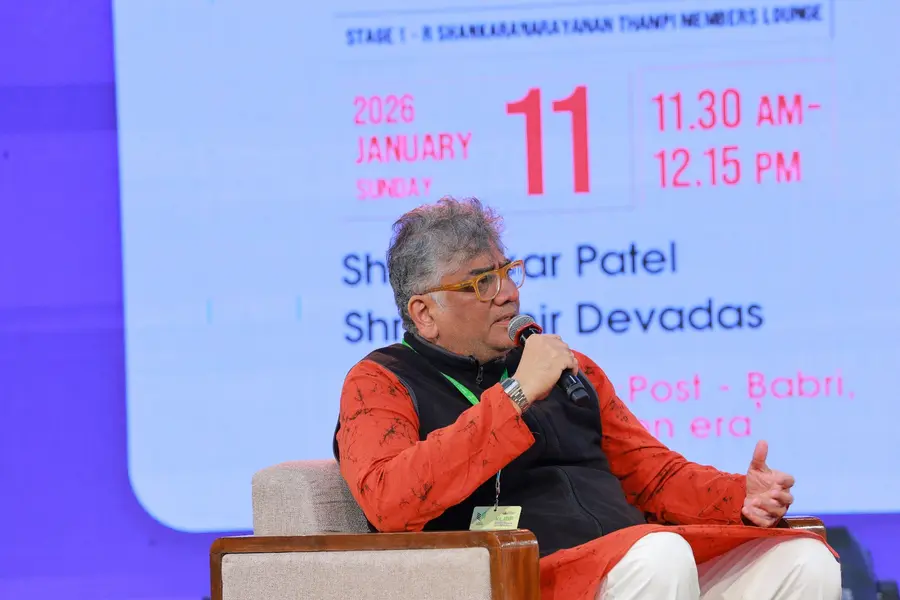
Aakar Patel at KLIBF 2026
Thiruvananthapuram: Writer, journalist, and activist Aakar Patel argues that the BJP discovered, through LK Advani’s Rath Yatra, that communal polarisation is an effective and repeatable route to mass mobilisation and political power, and therefore the party has no intention to abandon this strategy.
He recalls that after the demolition of the Babri Masjid in 1992, BJP leaders claimed their objective was complete and that communal mobilisation would end. However, once the party realised that religious polarisation could consistently deliver electoral power, it became a permanent political method. Patel emphasised that over 3,000 people were killed during the Rath Yatra period, underlining its human cost.
Speaking at the Kerala Legislative Assembly Book Festival, in a discussion titled “India After ’91: Post-Babri, Post-Liberalisation Era” with Sudheer Devadas, Patel noted that BJP-ruled states institutionalised communalism through laws such as beef bans, cow slaughter prohibitions, and “love jihad” legislation.
He cited a case from Gujarat, where a Muslim man was sentenced to 10 years in prison for allegedly serving beef at his daughter’s wedding—despite laboratory tests failing to confirm the meat was beef. The court ruled that the burden of proof lay with the accused, not the police, which Patel highlighted as a dangerous legal precedent.
Patel also pointed out that since 2019, only Muslim divorce cases are treated as criminal cases, while divorces among other communities remain civil matters—indicating institutional discrimination.
On the Congress, Patel criticised the party for lacking the courage to repeal BJP-era communal laws. Even after returning to power in Karnataka, Congress has not repealed the “love jihad” law due to fear of public backlash. “Congress does not want to fight these battles every day,” he said.
Regarding South India, Patel argued that although regions like Kerala are relatively better off socially, they are numerically too small to counter India’s overall communalisation, as political power is concentrated in North India. He remarked candidly that South Indians are, to some extent, comfortable in their political helplessness. Patel, originally from Surat and now living in Bengaluru, said he left Gujarat because it was no longer possible for him to live there safely.
On delimitation based on population, he warned that if not handled carefully, South India could be punished for successfully controlling population growth.
India vs China
Patel identified two key differences between India and China:
Greater state involvement in development in China and China’s ability to set aside geopolitical disputes and focus on economic expansion through trade agreements with Asean countries.
India, he argued, has failed on both counts.
Economy and Media
Patel described India as an economic underperformer, noting that comparisons with Bangladesh are made only because India cannot compete with China. He said India’s major corporations like Adani and Ambani do not produce export-driven consumer goods, unlike companies such as Samsung or Xiaomi.
He expressed pessimism about India’s future, observing that post-1991 liberalisation benefited the English-educated middle class, but by 2010, opportunities shrank. Today, even middle-class youth are pushed into gig work.
Finally, Patel criticised Gujarati and Hindi media, stating that while they may criticise the government on economic or administrative issues, they largely support the government’s communal agenda. He added that even English-language media, which once resisted this trend, has now largely fallen in line.
Tags



Related News
Dont Miss it









0 comments