
A Hemisphere at Crossroads: US Strike on Venezuela and Reverberations on Global Geopolitics

Rahna Mariyam
Published on Jan 07, 2026, 03:54 PM | 5 min read
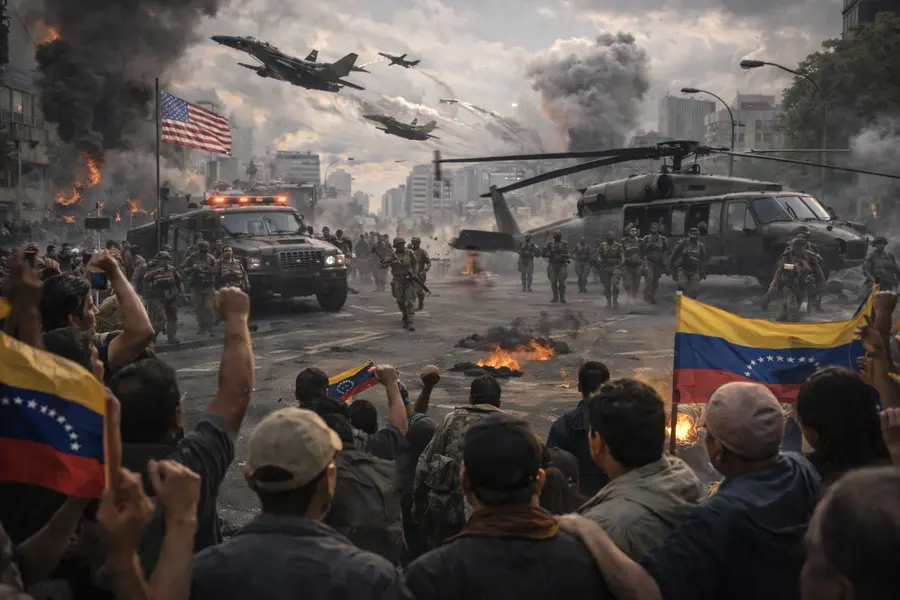
On the morning of January 3, 2026, the quiet streets of Caracas were shattered by the sound of military jets and explosions -- a dramatic signal that the United States had launched its most direct military intervention in Latin America in decades. At the center of the operation was Venezuelan President Nicolas Maduro, forcibly removed from power and transported to New York to face federal charges.
The rapid sequence of events has reverberated around the world, exposing deep divisions over international law, strategic interests, and the future of U S relations with its southern neighbours. What began as months of rising geopolitical tension -- couched in rhetoric about combating narco-terrorism and restoring democracy -- has expanded into a full-blown crisis with global implications.
A Military Blitz and Political Upheaval
In the pre-dawn hours of January 3, American military aircraft and special operations forces struck key Venezuelan military infrastructure in and around the capital Caracus, including air bases and strategic facilities. Within hours, Maduro and his wife, Cilia Flores, were in US custody. The Trump administration framed the operation as a an action against a “narco-terrorist state,” though many international experts have rejected that justification as insufficient under widely accepted norms governing the use of force.
Back in Washington, President Donald Trump declared the operation a success, even as critics accused his administration of bypassing US constitutional procedures -- including notifying Congress -- and flouting global standards of sovereignty.
Meanwhile, within Venezuela, in the face of an attack against their sovereignty, the nation united to voice their protest against America's action. Despite the crisis, and pressure from US, who had been favouring Nobel peace prize winner Maria Corina Machado, an interim government led by Vice President Delcy Rodriguez has attempted to maintain order in the country, while armed militias known as colectivos patrol city streets, heightening tensions and perpetuating fear among residents.
Oil, Geopolitics, and Economic Stakes
Central to the US strategy is Venezuela’s vast petroleum wealth -- the largest proven oil reserves in the world. Four days after the incursion, President Trump announced that interim authorities will release between 30 and 50 million barrels of Venezuelan oil to the United States, with the proceeds to be managed by US officials. American oil companies are poised to return to Venezuelan fields long dormant or damaged by years of under-investment.
Critics argue these moves underscore that control of strategic natural resources -- and not a narrow “war on drugs” -- was the principal objective. Venezuela’s reserves, though under-producing relative to their potential, represent a major prize in global energy markets.
Now, the man who informed his rich friends in the board rooms of American oil companies before and after the "super secret" military strike in Venezuela--his own words-- is in control of those resources.
Regional Alarm and International Condemnation
US military action has resonated strongly across Latin America. Governments and civil society groups throughout the region have voiced alarm at the use of force. Colombia, which shares a border with Venezuela, called an emergency session of the United Nations Security Council to condemn what it described as a violation of international law.
In Mexico, longstanding principles of non-intervention have been reaffirmed as officials seek to strengthen national defences in the face of Pentagon threats that extend beyond Caracas. Many Latin American nations fear a broader campaign of coercive diplomacy, mainly because Trump himself has expressed his desire to expand United States' control over the western hemisphere.
At the United Nations, Secretary-General Antonio Guterres expressed “deep concern that rules of international law have not been respected,” underscoring the crisis’s potential to unsettle global norms.
Amidst all these reactions, in the days since then, the US President made further threats to other South American nations like Colombia, and Cuba, while eyeing to establish control over Greenland-- another strategically important territory, known for its rich resources and geopolitical position between the US and Europe, making it a significant "item" in Trump's wish list.
Global Power Dynamics in Play
The US action has also crystallized strategic calculations beyond the Western Hemisphere. Analysts in Beijing have suggested that China could leverage US unilateralism to portray itself as a stabilizing force, particularly in contrast to Washington’s unpredictable use of military power.
In Western capitals, questions linger about the long term consequences -- from potential escalation in energy prices to mounting geopolitical rivalries -- and whether Trump’s bold gambit might embolden other powers like Russia and China --both who have been eyeing to take control of other nations like Ukraine and Taiwan-- to flout international norms for their own ends.
As Venezuela’s streets remain tense, and as Maduro awaits trial in New York, the reverberations of January 3 extend far beyond Caracas. Latin American nations are reassessing alliances, Europe and Asia are weighing diplomatic and economic responses, and international analysrts warn that the precedent set by US may be difficult to reverse.
Whether the global community can forge a coherent response that balances security, sovereignty, and humanitarian concerns remains to be seen. What is certain is that once the smoke of conflict clears, the geopolitical and moral questions raised by the US strike on Venezuela will linger for years-- if not for decades.



Related News
Dont Miss it








0 comments