
Trump's Prime-Time Speech on West Asian Conflict: Same Old Claims, No Clear Answers
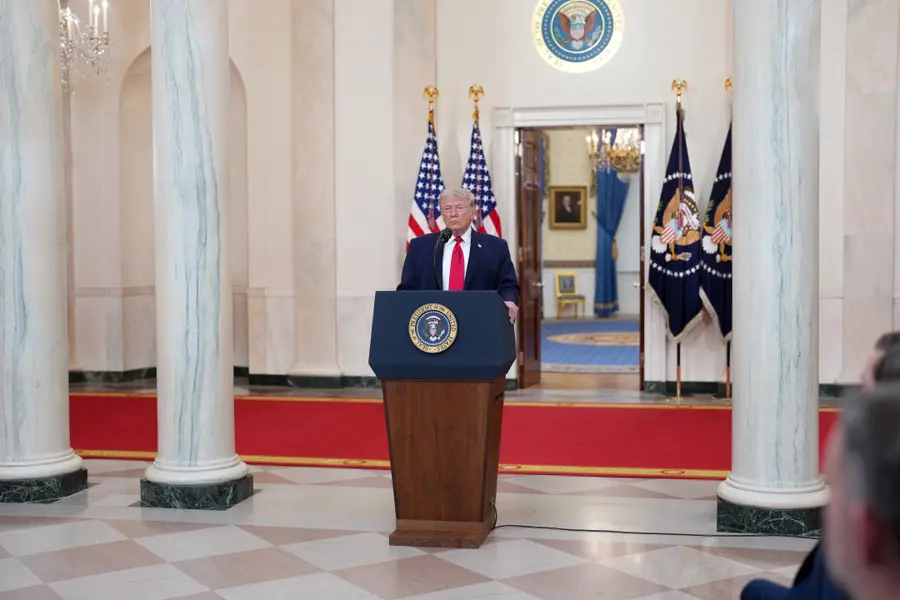
US President Donald Trump speaks during a televised address on the conflict in West Asia from the Cross Hall of the White House in Washington, DC on April 1, 2026. (Phot | AFP)

Rahna Mariyam
Published on Apr 02, 2026, 02:23 PM | 5 min read
Washington DC: On Wednesday, when White House officials announced that President Donald Trump would be addressing the nation, everyone expected him to deliver a major announcement — a turning point in the ongoing conflict in West Asia. Instead, throughout his nearly 20-minute speech, all he did was repeat the same warnings and statements.
While US, and indeed the world, was hoping for him to bring an end to what critics and international legal experts have described as an unlawful war waged alongside Israel, he doubled down on his earlier rhetoric. He kept insisting that the war was necessary while claiming that the US has already won and will finish it very soon — a failed attempt to calm an increasingly agitated public.
The prime-time telecast was essentially a roundup of his remarks and social media posts since the war started on February 28. While he and his administration are trying to make people believe they are on the winning side, there is no tangible evidence so far to prove that claim. In contrast, there is considerable evidence to suggest the opposite.
The central issue with Wednesday's speech is that even he does not appear to know where the finish line is. He has been saying for weeks that the US has won — but has never made clear what factors would constitute a victory. Is it regime change, disarming Iran, destroying their military, crippling their economy, seizing their oil reserves and resources — or does it inherently mean simply siding with Israel and letting them decide when to stop the war?
The US President's unprovoked military action against Iran has not only placed the US under immense pressure, but the entire world is bearing the brunt of it. A fuel and gas crisis — a direct byproduct of the conflict — has put every country under immense pressure. Fuel, gas, and crude oil prices have risen steadily since the war began. While Trump claims the US is winning, those rising prices are already stoking domestic pressure in US as well.
The fuel crisis, however, is only one front on which Trump's miscalculations have become evidently visible. He did not expect Iran to sustain its resistance for over a month, nor fight back with the ferocity it has demonstrated. In a separate and equally unexpected development, most of his NATO allies chose to distance themselves from what critics and analysts regard as an illegal war on Iran — a reaction Trump clearly did not foresee, given how openly confident he had been that they would fall in line without question. His response to their refusals spiralled out of control, raising the possibility of a serious rupture within NATO.
Adding to these pressures, the tide has turned at home as well. Across the country, citizens have taken to the streets under the banner of "No Kings" — a growing protest movement rejecting what demonstrators describe as authoritarian overreach by the Trump administration — making clear that the public, too, is no longer willing to stay silent.
Wednesday's address to the nation did little to resolve any of these mounting pressures or calm his own citizens. Trump offered no timeline, no defined objectives, and no diplomatic roadmap. He did not address the fate of the civilians caught in the crossfire in Iran, nor did he speak to the broader humanitarian crisis unfolding across the region. He didn't even attempt to mention the death of 165 girls in Minab following a US strike.
He made no mention of ceasefire negotiations with Iran, back-channel diplomacy, or any engagement with international bodies such as the United Nations, which has repeatedly called for a halt to hostilities. The question of what a post-war West Asia looks like — who rebuilds, who governs, who is held accountable — remains entirely unanswered as reports emerged that Trump might ask his West Asian counterparts to cover the financial burden from a war he started.
On the ground, the conflict shows no signs of slowing down. Iran continues to retaliate with drone and missile strikes, Strait of Hormuz remains closed, Gulf shipping lanes remain disrupted, and regional actors including Hezbollah and Houthi forces have shown no indication of standing down. The war that Trump insists is nearly over is, by most observable measures, still very much ongoing.
What Wednesday's speech ultimately revealed was not a commander-in-chief with a clear strategy, but a president struggling to reconcile his claims of victory with a reality that refuses to cooperate. Until Trump defines what winning actually means — and charts a credible, transparent course toward it — his addresses to the nation will continue to raise more questions than they answer. For the people of West Asia bearing the heaviest cost of this conflict, that ambiguity is not merely a political inconvenience. It is a matter of life and death.



Related News
Dont Miss it








0 comments