
National
What the Savarkars Did During a Time of Famine

Sreekumar Sekhar
Published on Jul 28, 2025, 09:43 AM | 4 min read
In 1943, during the Bengal Famine—one of the worst humanitarian crises of the 20th century—an estimated three million people died. As famine swept across the region, relief efforts began flowing in from across the country in the form of food, money, and medical aid.
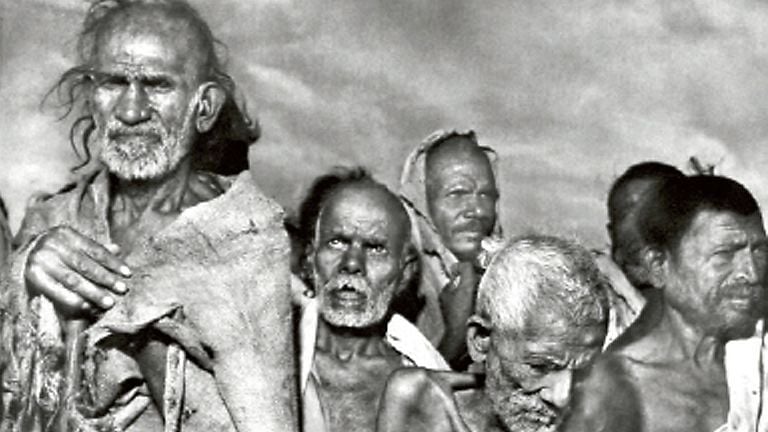
(During the Bengal Famine)
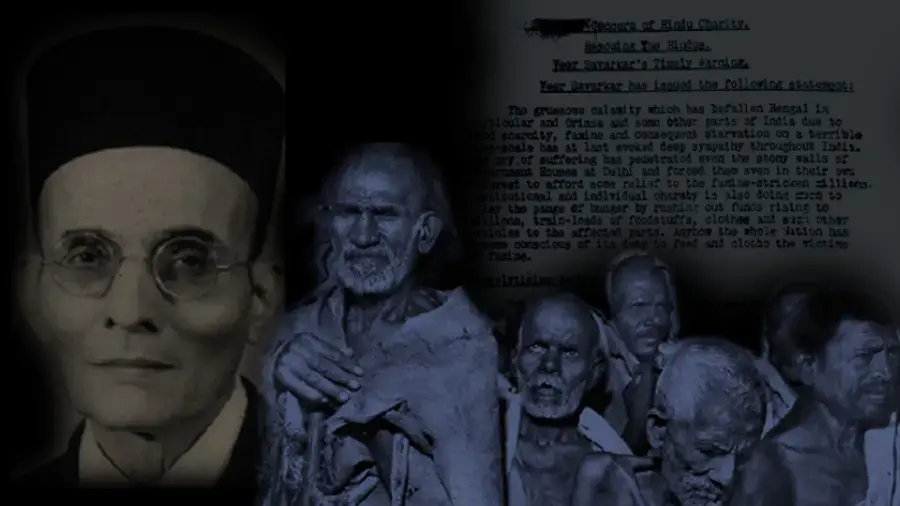
Amid this widespread suffering, a controversial statement was issued by VD Savarkar, then president of the Hindu Mahasabha, based in Bombay. In a message published in several newspapers between November and December 1943, Savarkar claimed that Muslims in Bengal were using food and aid as tools to convert Hindu women and children to Islam.
“Hindu organisations and individuals should offer help only to suffering Hindus. That aid must not reach Muslims”
He also alleged that Hindu relief funds, including those from organisations like Ramakrishna Mission and the Bengal Relief Committee, were being diverted to Muslims, while Muslim organisations were using their resources to convert Hindus.
Based on these claims, Savarkar urged that Hindu organizations and individuals should provide assistance only to Hindus and ensure that aid did not reach Muslims. This statement was recorded in official files from December 1943 (File No. 87/45-PolK I, National Archives of India) and was forwarded to Sir Reginald Maxwell, the Home Secretary of British India.
“Muslims in famine-stricken Bengal are converting Hindu women and children by denying them food and aid unless they renounce their religion.”
In his assessment, Maxwell noted that although Savarkar had limited influence in Bengal, his remarks were highly inflammatory and could trigger communal tension. He advised the Bengal government to consider legal action.
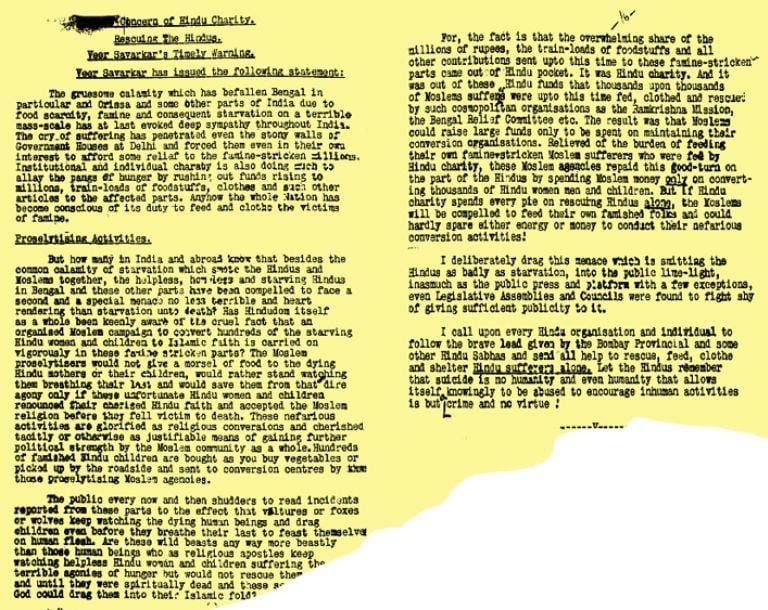
(Savarkar's statements - National Archives)
He further claimed that funds provided by Hindu organizations like Ramakrishna Mission and the Bengal Relief Committee were going entirely to Muslims. According to him, Muslim organizations were allegedly using their resources to convert Hindus. Therefore, he urged that Hindu organisations and individuals should help only Hindus in distress, and ensure that aid does not reach Muslims.
This statement is also part of the answer to the question: “What did Savarkar do after being imprisoned in the Andaman Jail and repeatedly writing petitions for clemency?” It is well known in history that he was later accused in the 1948 assassination of Mahatma Gandhi.
Many individuals and organisations active in famine relief rejected Savarkar's allegations. Even some leaders within the Hindu Mahasabha, including Syama Prasad Mukherjee, declined to support his claims. The Bengal government also dismissed the accusations.
(Amtus Salam)
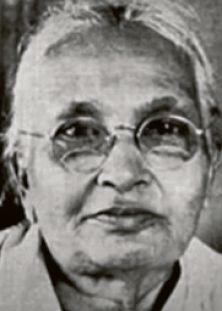
The issue reached the attention of Mahatma Gandhi, who asked Amthus Salam—his close associate and often referred to as his adopted daughter—to investigate. She travelled to Bengal and conducted a detailed inquiry, speaking with relief workers and representatives of both Hindu and Muslim organisations. Her findings were later published by the Associated Press.
According to her report, there was no evidence of forced religious conversions or discrimination in the distribution of aid. She noted that relief organizations—including the Marwari Service Society, Arya Samaj Relief Committee, Muslim Chamber of Commerce Relief Committee, and Ramakrishna Mission—were helping people regardless of their religion or caste. She also interviewed Bhagirath Kanoria, Secretary of the Bengal Relief Committee, who confirmed that no incidents of religious conversion had been reported.
“There was never any attempt, anywhere, at any time, to convert Hindus to Muslims or vice versa.”
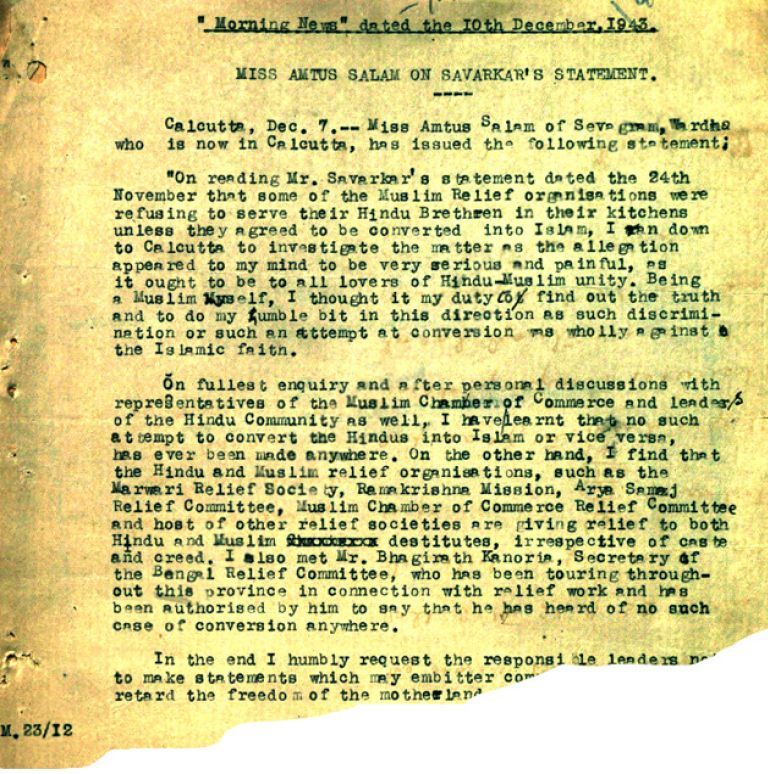
(Report submitted by Amtus Salam - National Archives)
Amthus Salam concluded her report by urging leaders not to make divisive statements that could undermine India’s struggle for independence. She emphasised that such actions delayed national unity and harmed relief efforts during a time of crisis.
“Leaders should not engage in actions—such as issuing communal statements—that only delay our nation’s freedom.”
The fact that even senior members of Savarkar’s own party did not support his claims raises questions about his true intentions. Some have argued that, having secured release from the Andaman prison through clemency petitions to the British, Savarkar may have been acting in ways that aligned with colonial interests.
Tags



Related News
Dont Miss it








0 comments