
Echoes of Injustice: The Tragic Killing of Ehsan Jafri and the Aftermath of the 2002 Gujarat Pogrom
Anjali Ganga
Published on Mar 06, 2025, 01:38 PM | 8 min read
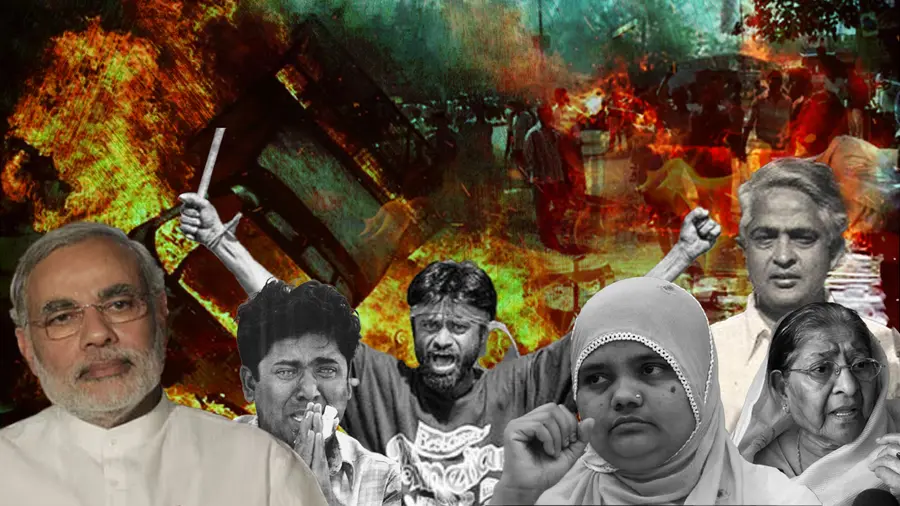
The 2002 Gujarat pogrom remains one of the most contentious and tragic episodes in India's modern history. Among the many lives lost, the brutal killing of Ehsan Jafri, a former Member of Parliament and a prominent Congress leader, stands out as a symbol of the violence that engulfed the state. While the riots were officially described as a spontaneous outburst of communal anger, many critics and human rights organisations have argued that the violence was systematic, state-sponsored, and politically motivated. As critics say, central to this narrative is the role of the Bharatiya Janata Party (BJP) government and it's inactiveness during the pogrom.
Ehsan Jafri and the Gujarat Pogrom: A Targeted Political Assassination
When Narendra Modi became Chief Minister of Gujarat in 2001, he inherited a state with a history of communal tensions. The BJP, under Modi's leadership, was accused of pursuing a Hindu nationalist agenda that marginalised minorities, particularly Muslims. The 2002 riots, which followed the Godhra train burning incident, were seen by many as a turning point in Modi's political career. Critics argue that the riots were not just a failure of governance but a deliberate strategy to consolidate Hindu votes and establish the BJP's dominance in Gujarat.
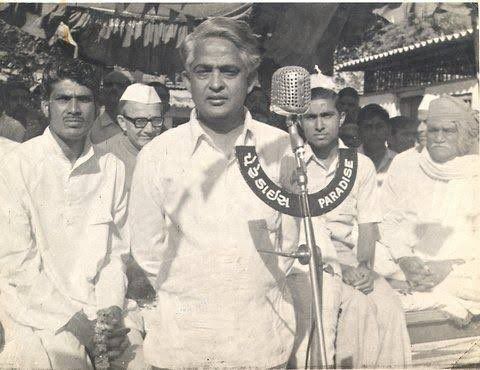 Ehsan Jafri
Ehsan Jafri was no ordinary victim. As a former Congress MP and a vocal critic of the BJP, he represented a political threat to the ruling party. His presence in the Gulbarg Society, a predominantly Muslim neighbourhood, made him a visible symbol of resistance against the communal forces gaining ground in Gujarat. On February 28, 2002, when a mob surrounded the Gulbarg Society, Jafri made desperate calls for help to police officials, politicians, and even the Chief Minister's office. No assistance came. He resisted the violent mob for five hours before giving up; he even tried to rescue as many people and send them to a safe place in the building.
The mob, armed with weapons and fuelled by hatred, broke into the society, setting homes on fire and attacking residents. Jafri was dragged out of his home, brutally assaulted, and killed. His body was later burned. The massacre claimed 69 lives, but Jafri's killing was particularly significant. Critics argue that his death was not a random act of violence but a calculated move to eliminate a political opponent and send a chilling message to the Muslim community.
Narendra Modi's leadership during the riots has been intensely scrutinised. Critics accuse him of disregarding the violence and, in some cases, actively enabling it. Reports suggest that the state machinery, including the police, failed to intervene effectively, allowing the mobs to carry out their attacks with impunity. Modi's alleged inaction during the riots has led to nationwide criticism.
Jafri's killing fits into this broader narrative. As a prominent Muslim leader and a Congress loyalist, his death served to weaken the opposition and reinforce the BJP's narrative of Hindu victimhood. The fact that the authorities ignored Jafri's pleas for help has been cited as evidence of a deliberate strategy to target political opponents under the guise of communal violence. In an interview with Zee television on March 1, 2002, Mr Modi is reported to have said that the massacre was a "reaction to an action.' Even though Modi denied saying so and said he was quoted out of context, this comment sparked debate over his influence in the riot.
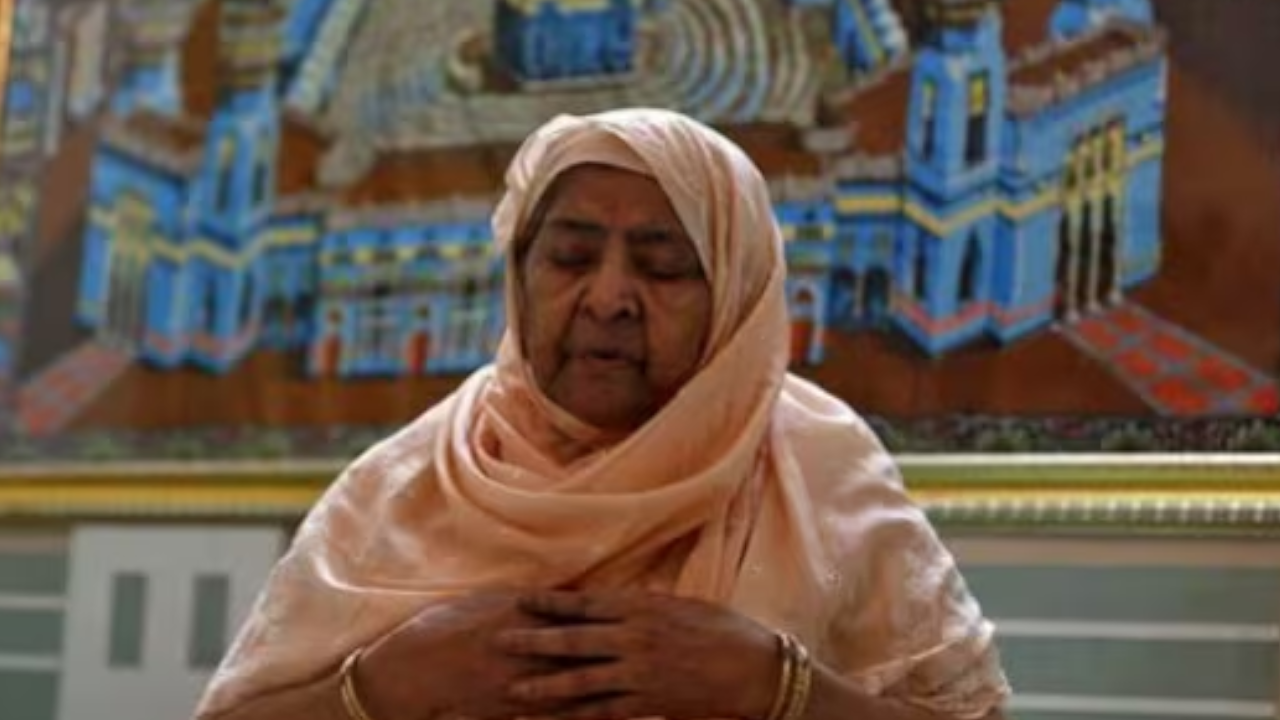 Zakia Jafri
Zakia Jafri's Unyielding Pursuit of Justice: A Legacy of Courage and Resilience
Zakia Jafri dedicated nearly two decades to fighting for justice for the victims of the Gujarat pogrom following the brutal murder of her husband, Ehsan Jafri, until her passing on February 1, 2025. In 2006, she courageously filed a complaint against the then Chief Minister of Gujarat and current Prime Minister, Narendra Modi, and other higher police officers about their involvement in the riot. The police, however, chose not to pursue charges. After the high court rejected her plea to investigate the Gujarat pogrom, Zakia moved to the Supreme Court. The Supreme Court intervened and established a Special Investigation Team (SIT) to investigate the matter. In 2012, the SIT concluded that there was no evidence of a larger conspiracy behind the riots. This finding has faced significant criticism, as many believe flaws and bias marred the investigation. In 2016, a special court convicted 24 individuals for their roles in the massacre, yet all were acquitted of murder charges. While eleven faced convictions for lesser offences such as rioting and arson, 36 others were acquitted due to insufficient evidence. For Jafri's family and numerous activists, this verdict starkly highlighted the systemic failures endemic to the pursuit of justice in the aftermath of the Gujarat riots.
The judges of the Gujarat High Court noted that the "inadequacy, inaction, and negligence' of the state government contributed to the destruction of religious structures throughout the state. Although the government compensated for the rebuilding of houses and commercial properties, it consistently refused to allocate funds for religious buildings, indicating a clear bias in the actions of the Modi government following the riots.
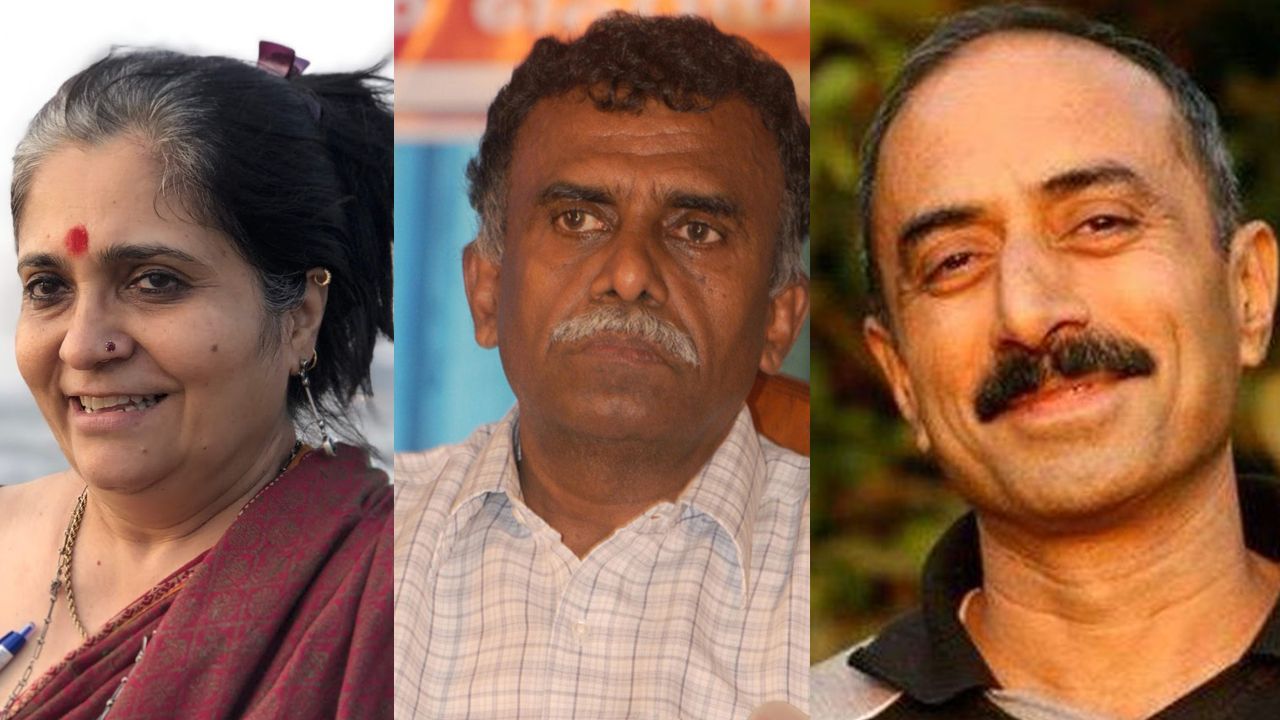 Teesta Setalvad, R B Sreekumar, Sanjiv Bhatt
On June 24, 2022, the Supreme Court dismissed the Gulberg Society case and upheld SIT's investigation as final. Supreme Court gave a clean chit to Modi and all accused in the case. Based on the Supreme Court verdict, on the very next day, Gujarat police filed an FIR against Teesta Setalvad, Retired IPS officer R B Sreekumar, and Former IPS officer Sanjiv Bhatt for allegedly fabricating a case with no merit. Teesta and R B Sreekumar were arrested on the same day from their residence; Bhatt, who was already in Jail, was brought to Ahmadabad. On July 2, they were remanded to 14 days in judicial custody.
The Gujarat government has, over the years, done everything in its power to block the legal process and deny justice to the riot victims. For example, targeting Setalvad, Bhatt, and Sreekumar, undermining their credibility through a sustained campaign. As a result, many of their supporters either lost interest or chose to stay silent, fearing the government's retribution. Even the media distanced itself from them. Despite these efforts to silence them, Setalvad, Bhatt, and Sreekumar never wavered in their quest for justice. Later Teesta and R B Sreekumar granted interim bail.
Ehsan Jafri's murder cannot be viewed as an isolated incident. It was part of a broader campaign of violence targeting Muslims and political opponents of the BJP. Critics contend that the riots were a spontaneous outburst of communal anger and a meticulously orchestrated effort to consolidate political power. In this context, Jafri's death was a calculated move aimed at removing a political threat and sending a violent message to the Muslim community.
Narendra Modi's ascent to national prominence, first as Chief Minister and later as Prime Minister, has been built on a fabricated narrative of decisive leadership and economic development. However, the shadow of the 2002 riots continues to loom large over his legacy. The death of Ehsan Jafri symbolizes the systemic failures and political machinations that defined the 2002 Gujarat riots. Despite the BJP and Modi's consistent denials of involvement in the violence, evidence and testimonies suggest a more complex and troubling reality. As the nation grapples with the legacy of 2002, a pressing question persists: Was Ehsan Jafri's killing a strategic manoeuvre in the BJP's political game? For many, the answer is an unequivocal yes.
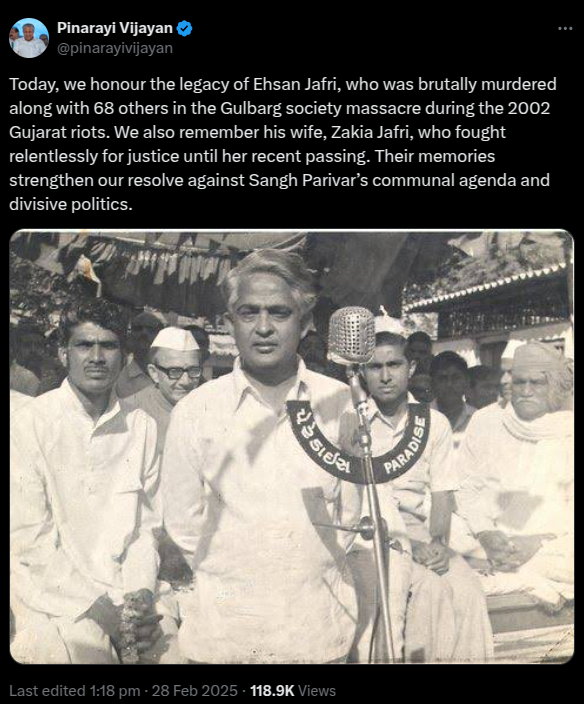 Chief Minister Pinarayi Vijayan remembers Ehsan Jafri on X, the social media platform
Congress's Silence on Ehsan Jafri: A Missed Opportunity for Justice
Despite the Congress party experiencing the tragic loss of an MP to the violent riots in Gujarat, it maintained a disturbingly long silence on the issue. Over the years, none of its leaders have dared to voice their concerns on social media. Zakia Jafri, a formidable opponent of the Hindutva agenda, passed away on February 1, and shockingly, only Kerala Chief Minister Pinarayi Vijayan took to social media to honour her memory. Congress has failed to acknowledge Ehsan Jafri even on his 23rd death anniversary, reflecting a purposeful oversight of the entire issue.
Films as propaganda tools
The Modi government has actively praised films that support Hindutva narratives, leading to a considerable overhaul of the previously negative portrayal of the RSS and BJP over the years. This effort includes rewriting history to present a polished and favourable view of these parties. The recent movie "Sabarmati Report," claiming to be based on the Godhra tragedy, is riddled with factual inaccuracies and misleading claims. Its clear intent is to serve as a political tool for the BJP to solidify its narratives as historical facts for future generations. Designated as tax-free in multiple states, the "Sabarmati Report" further promotes Hindutva ideology and receives encouragement from the central government.



Related News
Dont Miss it





0 comments