
Shelter, Safety, and Strength: Mundakkai Survivors Find New Hope in Kalpetta

Web desk
Published on Aug 02, 2025, 09:27 AM | 4 min read
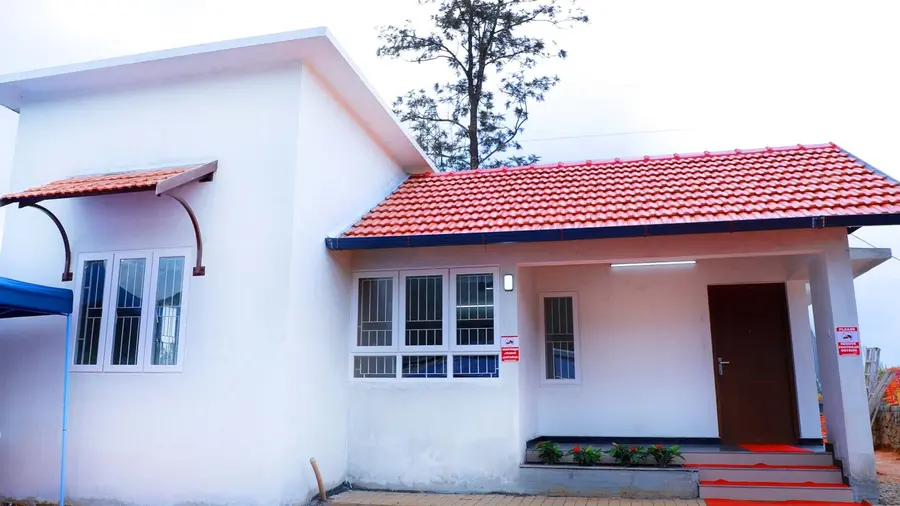
Wayanad: A year after the devastating landslide in Mundakkai, the Kerala government is making steady progress in rehabilitating the affected families. A township is taking shape in Kalpetta, Wayanad, with 410 disaster-resilient houses designed to withstand both floods and earthquakes. Construction is underway across five zones on 64.47 hectares of land acquired by the government from Elston Estate. The first model house, built on seven cents of land and covering 1,000 square feet, was completed within 105 days despite heavy monsoon challenges. It was opened for public and survivor visits on Wednesday.
Each house in the township is a single-storey structure, built with flood- and earthquake-resistant technology. Instead of the conventional method of laying walls directly on the foundation, the construction uses a framed structure technique. Concrete frames are erected first, and fly ash bricks are used to build the walls between the columns. Soil testing is carried out on every plot before foundation work begins. Foundations are dug to a depth of 1.5 to 2.5 meters, or more in areas where soil conditions demand it. More than 25% of each house’s total cost is spent on foundation work alone. The visible height of the house matches the height of its underground foundation, which is strong enough to support the construction of up to three floors in the future.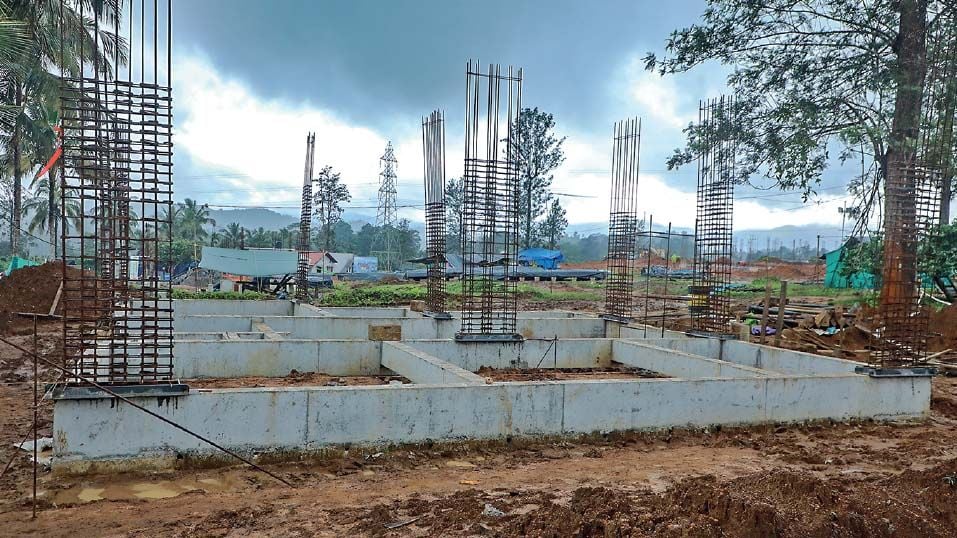
Each house includes nine reinforced concrete pillars—each 90 cm wide and 20 cm thick—along with a plinth beam 20 cm wide and up to 60 cm thick. To suit local climate conditions, the homes feature seven doors and twelve windows. All windows are made of polyvinyl chloride. Anti-fungal paint is applied after cleaning the concrete frame before wall finishing. The interiors are tiled with vitrified tiles, while the sit-out areas are finished with granite. The tiles are laid over a 7.5 cm thick concrete base.
Each house in the township includes two bedrooms, two bathrooms, a living room, dining area, sit-out, study room, kitchen, and work area—adequately equipped for a small family. A compound wall and interlocked courtyard are also part of the construction. Rather than assigning a fixed price per house, the entire township is being developed under a 299-crore-rupee Engineering Procurement Construction (EPC) contract.
Based on DSR 2021 technical estimates, the construction cost of each house (excluding GST) was projected at Rs 31.5 lakh. However, the Uralungal Labour Contract Society is building each unit for 22 lakh to 24.5 lakh rupees—about 30% below the government estimate—without compromising on quality. This cost includes all basic amenities, compound walls, interlocks, and solar panel installation.
The broader township infrastructure includes a 12-meter-wide main road and separate access paths to each housing cluster. A health center, anganwadi, public market, library, community center, multipurpose hall, playgrounds, electricity substation, sanitation system, and drinking water facilities are also part of the master plan.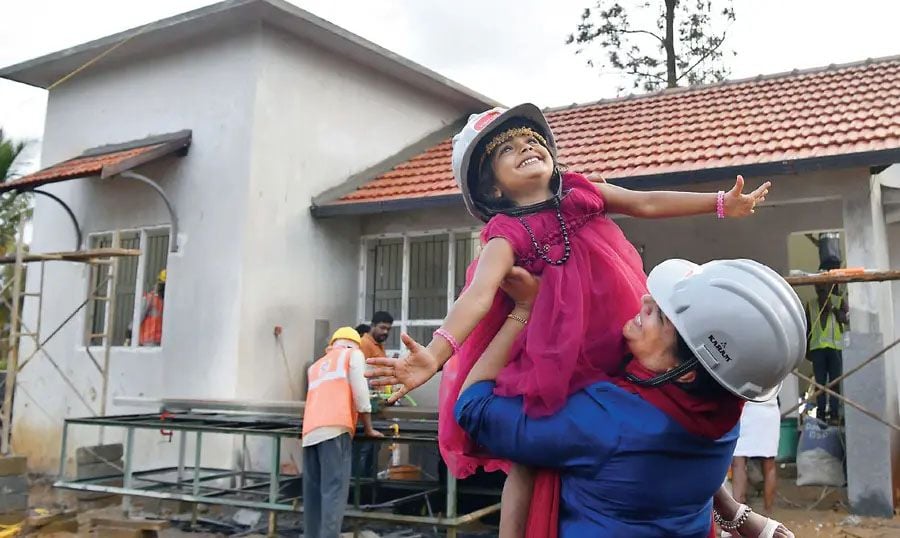
Construction began on April 13. As of now, foundations have been completed for 122 houses. Soil testing has been done for 51 plots, foundations laid for 27, and pillars raised for 20 homes. The government acquired the required land and cleared all legal procedures within just seven months after the landslide.
Each house is handed over with a five-year warranty covering structural defects, with the Uralungal Labour Contract Society responsible for resolving any such issues. In addition, the contract provides a five-year warranty for general maintenance, a three-year warranty for electrical systems, and up to 20 years of warranty for doors, windows, and bathroom fittings. The main door and kitchen exit door come with a 10-year warranty, while the paint carries a seven-year warranty.
All 410 houses are expected to be completed by December 31.



Related News
Dont Miss it









0 comments