

A Room That Sees a City: Trivandrum's 24x7 Eye on Safety, Cleanliness, and Order
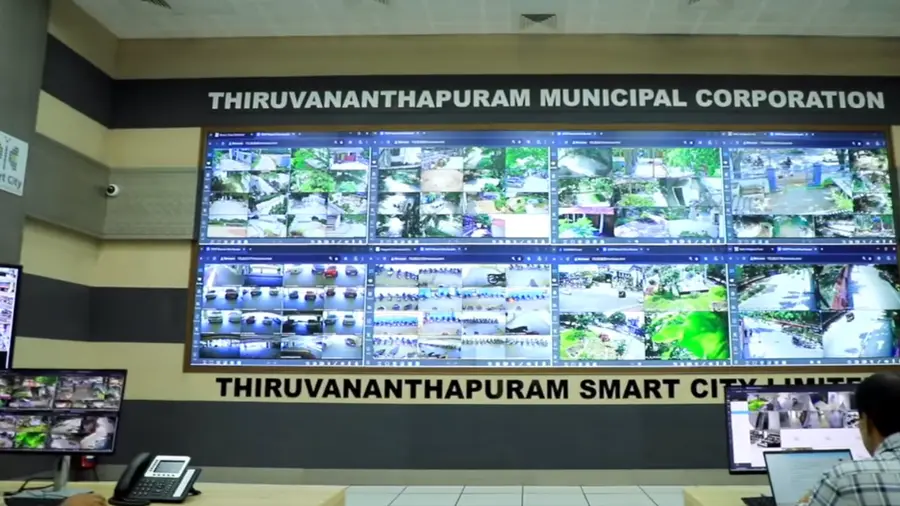
There’s a room inside the Thiruvananthapuram Corporation building where the entire city unfolds on a giant LED wall. From traffic violations and garbage dumping to the movement of city buses and changes in air quality — everything is under constant watch, 24 hours a day. This is not a new setup. For the past few years, Trivandrum has been operating one of the most advanced urban surveillance systems in the country under the Smart City project, powered by two integrated centres: the Integrated Command and Control Centre (ICCC) and the Traffic and Safety Command and Control Centre (TSCCC).
At the ICCC, located adjacent to the Corporation's main office in Palayam, thousands of high-definition cameras installed across bus stops, parks, public spaces, and roads stream live footage into one digital nerve centre. Officials monitor this feed around the clock. What makes it more powerful is the real-time Artificial Intelligence (AI) system connected to these cameras. For example, if someone dumps garbage on the roadside, the system immediately identifies the offender. If it's from a vehicle, the AI extracts the RC (Registration Certificate) details and sends it to the Corporation’s dashboard, along with video proof. The officer-in-charge verifies the incident, imposes a fine, and sends a notice to the vehicle owner. If a person is caught dumping waste by hand, the system captures their face and sends the image for action.
More than 20 surveillance cameras are specifically deployed along the Amayizhanchan Canal to prevent pollution. At the same time, the ICCC keeps an eye on over 500 city buses of KSRTC using GPS tracking. Real-time air quality data and a smart mosquito density tracking system are also integrated. The mosquito tracking setup helps the health department identify areas with high mosquito concentration — including the type and density — so that fumigation can be targeted and effective.
Parking management is also under this smart eye. Handheld devices help traffic wardens manage roadside parking, while available spaces in the Corporation’s multi-level car parking facilities can be viewed in real time at ICCC. In its next phase, the centre will also integrate telecommunication tools distributed to fish workers along coastal areas for receiving emergency alerts and weather predictions.
One of the most sophisticated extensions of this citywide monitoring system is the TSCCC — now officially handed over to the City Police — focused entirely on traffic. This centre is equipped with the Adaptive Traffic Control System (ATCS), Integrated Traffic Management System (ITMS), Automatic Number Plate Recognition (ANPR), and Red-Light Violation Detection (RLVD). These technologies have turned Trivandrum’s traffic system into a near-automated network.
The ATCS uses live traffic data to adjust signal timings dynamically based on the actual flow of vehicles. The ITMS centralises signal operations while flagging any unusual activity on the roads. ANPR captures the number plates of all moving vehicles, helping identify stolen or suspicious ones. The RLVD system watches intersections 24×7, capturing both front and rear number plates of vehicles that jump signals. Its built-in Optical Character Recognition (OCR) software reads the registration details and sends violation notices instantly.
These AI-powered systems have changed how traffic law is enforced in the capital. No longer dependent on manual checking or on-the-spot policing, Trivandrum’s traffic violations are now tracked, processed, and penalised digitally — often within seconds of the incident.
Beyond traffic and sanitation, the ICCC is also connected with K-Smart, the Corporation's digital governance platform for public service delivery, file tracking, and waste management. The idea is to create a centralised platform where various departments — the Corporation, the police, the transport department, and health wings — can coordinate seamlessly during emergencies or routine operations.
With an investment of Rs 94 crore under the Smart City initiative, Trivandrum’s surveillance network has evolved into a smart, responsive system that sees and responds faster than ever before. While it may be invisible to many, inside a room in the Corporation building, the city is being watched — not just for safety, but for a smarter, cleaner, and more accountable urban life.













0 comments