
Kerala
Kerala Drafts EV Policy to Bridge Charging Gaps and Electrify Freight

Anusha Paul
Published on Sep 26, 2025, 01:11 PM | 4 min read
Thiruvananthapuram: According to a new study presented at the Shoonya Conclave organised by the Kerala State Electricity Board (KSEB), NITI Aayog and think-tank Rocky Mountain Institute, despite Kerala's strides in building electric vehicle (EV) infrastructure, significant gaps remain in the state's EC charging network, especially in high-range areas, inter-district routes, and freight corridors.
The study, titled Spearheading Kerala’s Electric Mobility Transition: A Study on Spatial Distribution and Heatmap Analysis of Fast Electric Vehicle Charging Stations, was conducted by KSEB’s EV Accelerator Cell with technical input from RMI. While the report acknowledged the state’s notable progress with over 440 public fast-charging stations and pole-mounted units already operational, it also highlighted that this infrastructure remains heavily skewed towards urban centres.
Major cities such as Kochi, Thiruvananthapuram, and Kozhikode enjoy robust charging station coverage. However, rural regions, interior state highways, and high-range districts continue to lag behind. The study pointed out that although districts like Wayanad, Idukki, Malappuram, and Palakkad currently have “favourable EV-to-charger ratios”—indicating infrastructure readiness ahead of demand—others like Thiruvananthapuram and Kasaragod face a strain where the pace of EV adoption is outstripping the rollout of charging facilities.
The district-level spatial analysis revealed under-served routes across the state. In the north, gaps were identified along the Kasaragod-Kannur-Kozhikode stretch of NH 66, the state highway between Kannur and Wayanad, and the Wayanad–Mysuru hill routes. In central Kerala, underserved stretches included Thrissur–Ernakulam–Alappuzha on NH 66, the Thrissur–Palakkad–Coimbatore section of NH 544, and the Malappuram–Palakkad–Coimbatore corridor. In the south, deficiencies were noted along the Kollam–Thiruvananthapuram NH 66 section and the Angamaly–Thiruvananthapuram stretch of the MC Road.
Tourism routes and high-range corridors also emerged as key problem areas. Specific gaps were reported in parts of Idukki district, including routes to popular destinations such as Vagamon, Thekkady, Kuttikanam, the Idukki Wildlife Sanctuary, and the pilgrimage centre of Sabarimala.
The report emphasised that Kerala’s EV ecosystem has reached an inflection point where future expansion must shift beyond urban and high-demand areas to ensure truly state-wide accessibility. It underscored the strategic importance of addressing infrastructure gaps not only for passenger mobility but also for freight movement and tourism connectivity. Bridging these gaps, the report noted, would reduce range anxiety and reinforce Kerala’s leadership in sustainable electric mobility.
As of May 2025, EV registrations in Kerala stood at 2,46,692, with electric two-wheelers leading, followed by private four-wheelers. EV penetration in the state has grown from just 1% in 2021 to 13% in 2025, according to data sourced from the Union Government's Vahan portal.
A New EV Policy
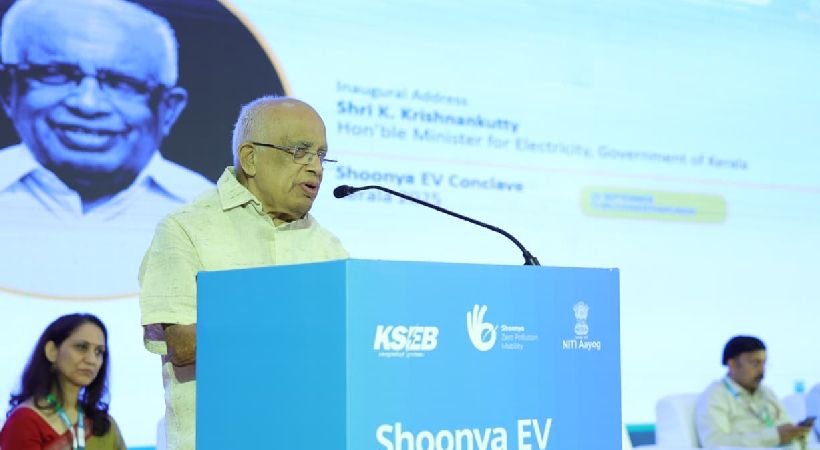 Minister for Electricity of Kerala, K Krishnan Kutty I Image Courtesy: Kairali
In response bridge the gap, the state government is drafting a new EV policy aimed at supporting Kerala’s ambition of becoming a net-zero carbon state. The policy will prioritise the electrification of freight transport and the rapid development of charging infrastructure.
At the Zero EV Conclave held as part of the Shoonya initiative, the KSEB presented a set of policy recommendations including financial incentives for EV adoption, increased charging infrastructure, loan facilities, awareness programmes, research and development support, and a dedicated grievance redressal mechanism.
A monitoring and oversight committee is also expected to be established to ensure smooth policy implementation. For personal-use electric vehicles, the KSEB has proposed a five-year exemption from road tax and registration fees.
To meet its ambitious climate goals, the state has set progressive EV adoption targets—13% of all vehicles by 2026, rising to 27% by 2030. The KSEB has also proposed the development of charging infrastructure along three critical transport corridors: Thiruvananthapuram–Mangaluru (NH 66), Kochi–Coimbatore (NH 544), and Dindigul–Kollam (NH 183). A carbon emissions reduction target of 15.94 tonnes by 2030 has been outlined as part of the policy.
The report concluded that addressing the present disparities in EV infrastructure is crucial to Kerala’s transition towards a low-emission transportation future.



Related News
Dont Miss it







0 comments