

India, UK Sign Free Trade Agreement, But At What Cost?
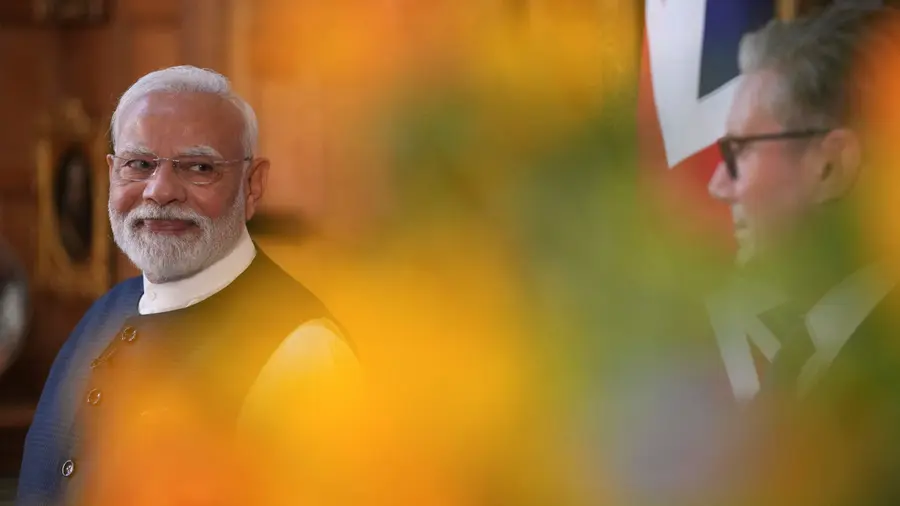
India's Prime Minister Narendra Modi (L) reacts as he speaks during a joint press conference with Britain's Prime Minister Keir Starmer following their bilateral meeting and the signing of a Free Trade Agreement, at Chequers, in Aylesbury, England, on July 24, 2025. (Photo by Kin Cheung / POOL / AFP)

Anjali Ganga
Published on Jul 24, 2025, 05:45 PM | 4 min read
London: India and the United Kingdom on Thursday signed a Free Trade Agreement (FTA), a deal marketed as a breakthrough but increasingly seen as one-sided, exposing Indian industries to structural vulnerabilities and long-term economic risks.
While the agreement is projected to boost bilateral trade by USD 34 billion annually, it also raises serious concerns about India's negotiating stance and its preparedness for the disruptive consequences of market liberalisation.
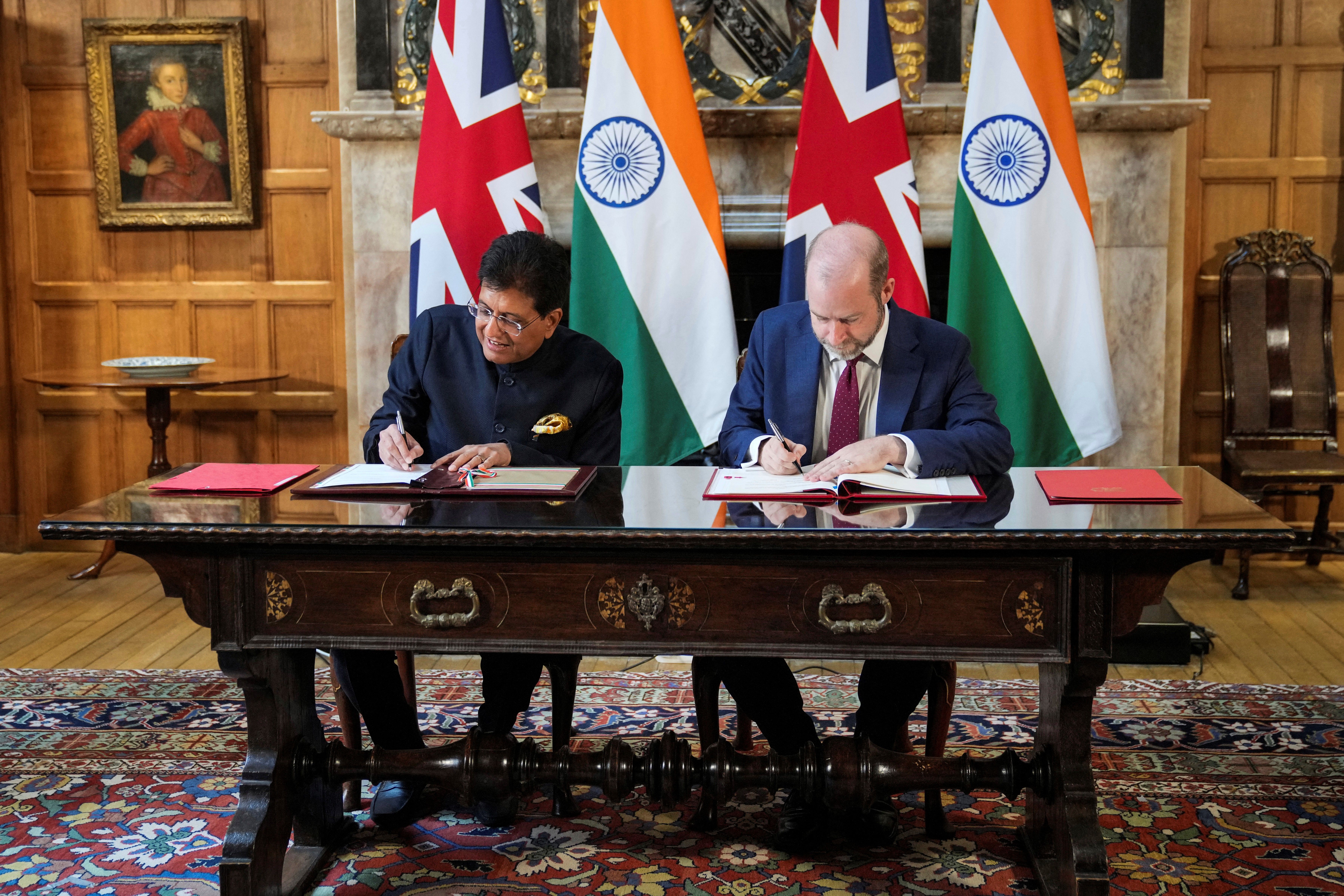 Britain's Business, Energy and Industrial Strategy Secretary Jonathan Reynolds (R) and India's Minister of Industry and Supply Piyush Goyal (L) sign a Free Trade Agreement during their bilateral meeting at Chequers, in Aylesbury, England, on July 24, 2025. (Photo by Kin Cheung / POOL / AFP)
Signed by Commerce Minister Piyush Goyal and UK Trade Secretary Jonathan Reynold in the presence of Prime Ministers Narendra Modi and Keir Starmer, the pact slashes tariffs on a broad range of goods, including British whisky and luxury cars, and removes duties on nearly all Indian exports. Yet critics argue this near-total opening of Indian markets offers few enforceable protections for fragile domestic sectors, making India disproportionately exposed.
While the UK has hailed the FTA as a strategic triumph, boasting that average tariffs on British exports to India will drop from 15 per cent to just 3 per cent, India's gains appear far less secure.
The promise of improved market access masks deeper weaknesses: from the absence of robust safeguards for Micro, Small and Medium Enterprises (MSMEs) to negligible progress on labour mobility and unresolved investment protection frameworks. After three years of negotiations, the final outcome seems tilted toward British commercial interests, rather than strengthening India's long-term economic resilience.
Beneath the celebratory announcements lies a troubling imbalance. India is opening its markets to heavily subsidised UK goods while receiving little in terms of structural safeguards, economic buffers, or genuine reciprocity.
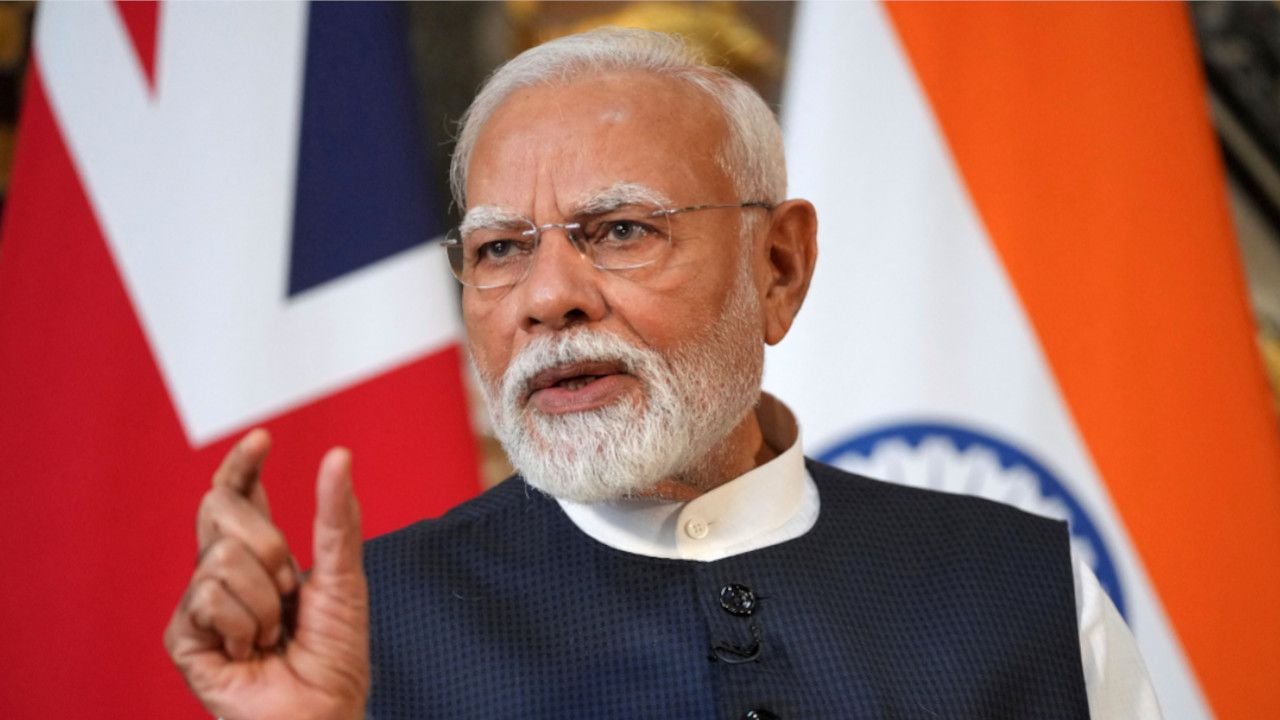 India's Prime Minister Narendra Modi speaks during a joint press conference with Britain's Prime Minister Keir Starmer following their bilateral meeting and the signing of a Free Trade Agreement, at Chequers, in Aylesbury, England, on July 24, 2025. (Photo by Kin Cheung / POOL / AFP)
Domestic Industries Face Asymmetrical Exposure
The FTA lowers long-standing tariff barriers that have shielded key Indian industries. British whisky and automobiles, previously taxed at rates between 100 and 150 per cent, will now enter Indian markets at substantially reduced duties, in some cases as low as 10 per cent. This exposes Indian manufacturers, particularly in the liquor and automotive sectors, to immediate and intense pressure. Unlike their British counterparts, Indian firms lack both state subsidies and comparable economies of scale.
MSMEs, the backbone of India’s domestic economy, are especially vulnerable. Although the UK market opens nominally, Indian MSMEs, especially in textiles, dairy, and processed foods, may find it difficult to meet the UK’s rigid certification and quality standards. Without technical and financial support, many could be squeezed out by a flood of cheaper, high-quality imports from the UK.
Meanwhile, India’s long-standing demand for enhanced labour mobility finds only token recognition. The deal caps work visas for Indian professionals at a mere 1,800 annually and provides no extension of post-study work rights for Indian students. Given the scale and global competitiveness of India’s skilled labour pool, the visa concessions are disappointingly narrow, and politically convenient for the UK.
Unaddressed Climate Tariffs, Investment Gaps
The FTA is conspicuously silent on climate -linked trade barriers, most notably the UK’s upcoming Carbon Border Adjustment Mechanism (CBAM), set to take effect in 2027. This will impose duties on carbon-intensive imports like steel, aluminium, and cement, sectors where India is a major exporter. Analysts estimate Indian firms could face additional costs exceeding USD 775 million annually. The absence of a mitigation clause or transitional buffer in the FTA effectively nullifies many of the tariff concessions on paper.
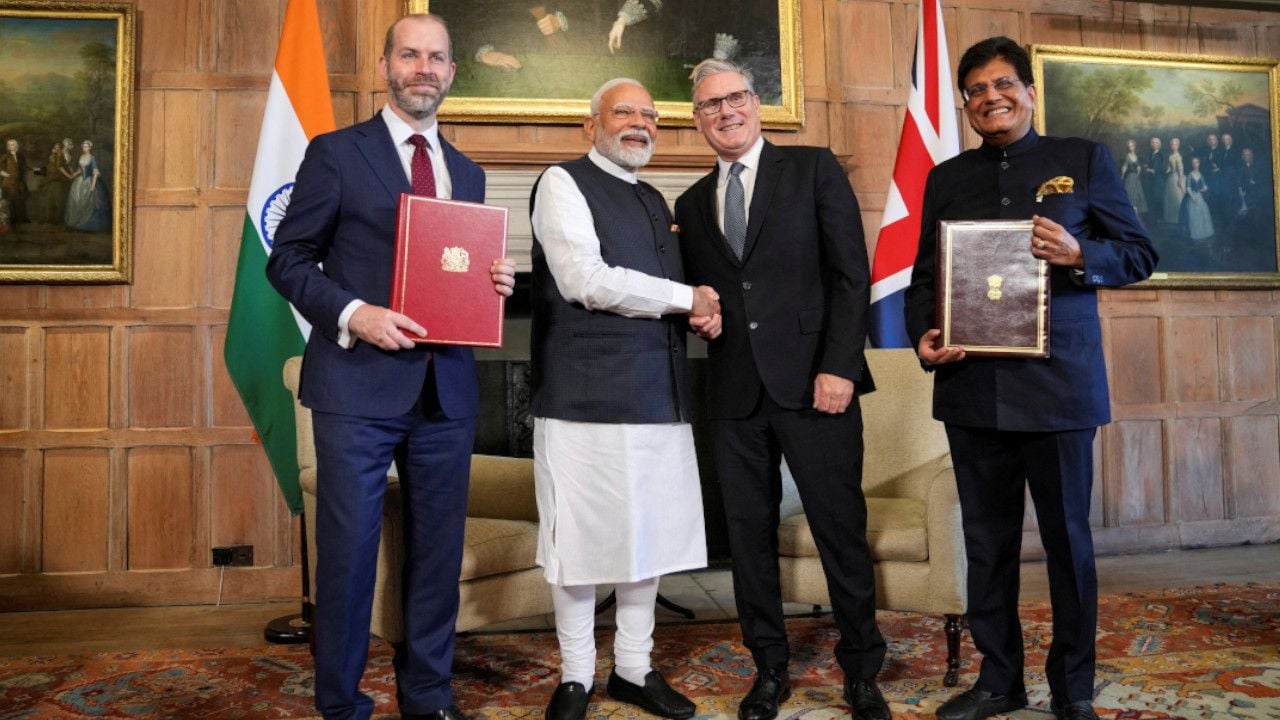 Britain's Prime Minister Keir Starmer (2nd R) and India's Prime Minister Narendra Modi (2nd L) shake hands next to Britain's Business, Energy and Industrial Strategy Secretary Jonathan Reynolds (L) and India's Minister of Industry and Supply Piyush Goyal (R) holding the Free Trade Agreement newly signed during a meeting, at Chequers, in Aylesbury, England, on July 24, 2025. (Photo by Kin Cheung / POOL / AFP)
Further compounding India’s vulnerability are Intellectual Property (IP) provisions that favour multinational pharmaceutical giants. Stronger IP protections introduced through the agreement threaten to undermine India's world-renowned generics industry, risking increased drug prices and restricted access to affordable medicines, particularly alarming given India’s vital role in global public health supply chains.
In addition, unresolved provisions in the Bilateral Investment Treaty (BIT) have left UK investors uncertain about legal protections and tax norms in India. The lack of clear dispute resolution mechanisms could deter the long-term capital inflows the FTA was supposed to encourage.
While the UK continues to support its export sectors with direct subsidies and robust industrial policy, especially in clean energy, advanced manufacturing, and tech, India’s relatively modest production-linked incentive (PLI) schemes leave its industries exposed. The imbalance creates an uneven playing field, glossed over by the rhetoric of mutual prosperity.
Framed as a win-win, the India–UK FTA ultimately reveals a stark asymmetry. It opens broad access for trade, but fails to secure India’s core economic interests. From climate -related trade costs and investor uncertainty to fragile MSMEs and meagre visa concessions, the deal reflects more diplomatic restraint than strategic foresight. Without serious renegotiation or the introduction of corrective measures, this so-called “landmark” agreement may be remembered less for its promises and more for the protections it failed to secure.



Related News
Dont Miss it









0 comments