

76 Regain Mobility in 1.5 Years: Kerala Firm’s G-Gaitor Now a Model for the Country
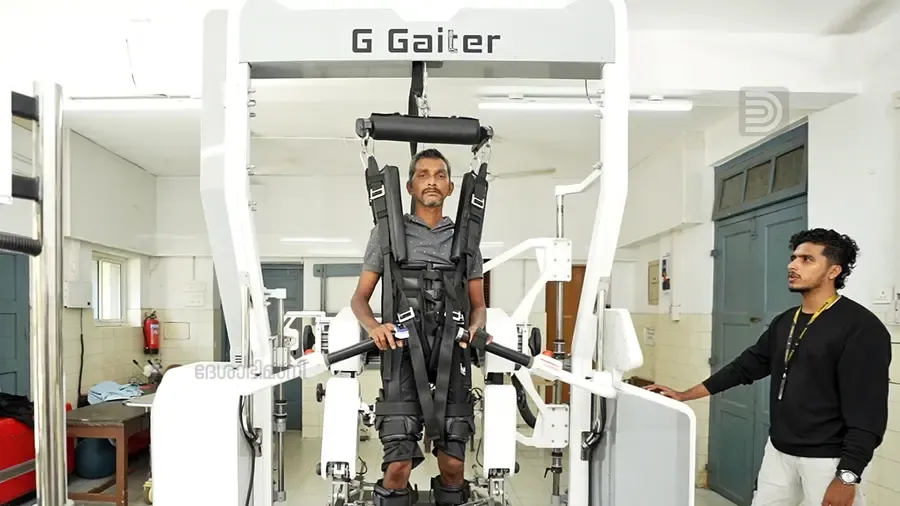
Nisamudheen undergoing therapy with G-Gaitor at Thiruvananthapuram General Hospital (File Photo)

Web desk
Published on Aug 01, 2025, 12:28 PM | 3 min read
Thiruvananthapuram: Nizamudeen, a resident of Beemapally in Thiruvananthapuram, was admitted to the city’s General Hospital after suffering a stroke that left him unable to walk. He was placed in the hospital’s Physical Medicine and Rehabilitation (PMR) block and underwent a month-long training programme using G-Gaitor, a robotic gait rehabilitation system. Gradual improvements were observed throughout the treatment, and by the end of the training, he was able to walk again. He has since returned home, regaining independence many thought was lost.
Nizamudeen is one among 76 patients who have regained mobility at the Thiruvananthapuram General Hospital with the support of G-Gaitor. The advanced gait rehabilitation robot was installed at the hospital in November 2023, making it the first government hospital in India to offer such high-end neuro-rehabilitation treatment. The facility has since become a state-level referral point, with patients arriving from all 14 districts of Kerala. The system allows up to five people to be trained each day.
G-Gaitor provides structured gait training for patients suffering from stroke, traumatic injuries, Guillain-Barré Syndrome, and other conditions that affect movement. Depending on the patient's condition, the training duration ranges from 10 to 30 days. The process involves detailed assessment and customised therapy under constant medical supervision. Emergency care is available on-site to manage complications such as blood pressure fluctuations during training.
A Kerala Innovation Changing Public Healthcare
G-Gaitor was developed four years ago by Kerala-based startup Genrobotics, which gained national attention for earlier innovations in robotics. The idea was born out of research focused on solving mobility issues faced by India's growing population of stroke survivors. According to available health data, over 1.5 crore people in the country live with disabilities caused by strokes. Added to that are thousands who lose mobility due to road accidents, falls, and other neurological conditions.
Experts highlight that if a stroke-affected person receives accurate treatment within the first 21 days, the chances of regaining mobility are significantly higher. However, delivering such intensive rehabilitation through conventional physiotherapy methods is extremely challenging. A physiotherapist is limited in how much repetitive movement they can offer in a day—helping a patient take 1,000 consistent steps daily is physically unsustainable in the long term.
G-Gaitor fills this gap by automating the repetitive gait training process through robotics and artificial intelligence. Its ability to execute controlled, high-frequency walking motions allows the body to relearn walking patterns more efficiently. The robot mimics natural walking and adapts to each patient’s condition, ensuring consistent training without fatigue—a task otherwise difficult for even the most experienced therapists.
The system also stands out for its affordability. While similar imported robotic gait trainers cost more than Rs 8 crore, Genrobotics developed G-Gaitor at a cost of just 1.5 crore. The lower cost has made it feasible for installation in hospitals, opening up advanced rehabilitation access to economically weaker sections of society. The developers say the robot was the result of seven years of research and clinical collaboration.
Since its installation, the Thiruvananthapuram General Hospital has seen a steady rise in demand for G-Gaitor-assisted therapy, with many patients reporting significant recovery within weeks. As successful outcomes continue to emerge, G-Gaitor is gaining recognition as a model that can be expanded to more government hospitals across the country, potentially transforming stroke rehabilitation in India.



Related News
Dont Miss it









0 comments